Did your order volume double overnight, but your fulfilment operation is buckling under the pressure? Late shipments, inventory errors, and overwhelmed staff can become the norm rather than the exception.
This is the growth ceiling that kills momentum. Without fulfillment scalability, every sales spike becomes a crisis instead of a celebration.
Fortunately, you can build systems that flex with demand rather than break under it. In this guide, we'll walk through five proven strategies to scale your fulfilment operations smoothly, so growth always feels like an opportunity, never a threat.
What Is Fulfillment Scalability?
Fulfillment scalability is your operation's ability to handle increasing order volumes without proportionally increasing costs, errors, or delivery times. A scalable fulfillment system maintains service quality whether you're processing 100 orders or 10,000 orders in a single day. This includes everything from warehouse capacity and labor management to technology infrastructure and carrier partnerships.
The distinction between growth and scalability matters. Growth means your order volume increases; scalability means you can handle that growth efficiently. A business might grow rapidly but struggle operationally if its fulfillment infrastructure wasn't designed to scale. True scalability requires planning for peak-demand periods, geographic expansion, and multichannel sales without building systems from scratch each time.
6 Challenges in Achieving Scalability
Scaling fulfillment operations presents obstacles that catch many businesses off guard. Being aware of these challenges helps you prepare before they become costly problems:
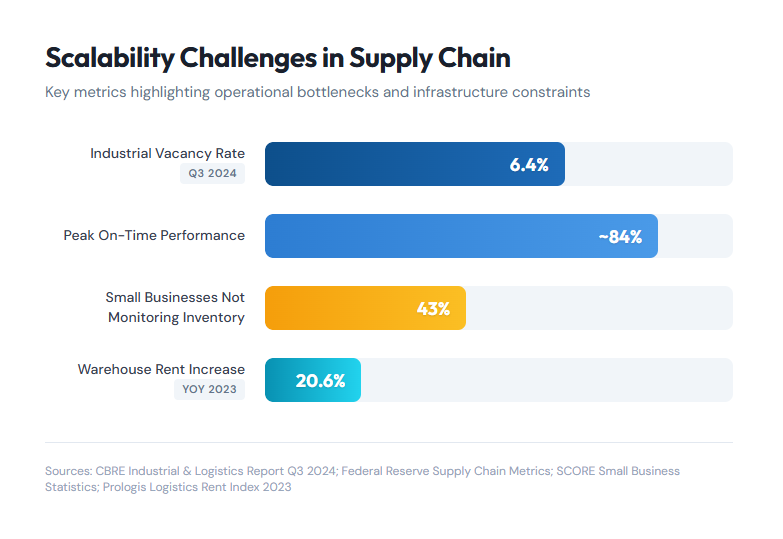
- Labor shortages and rising costs. Warehouse vacancy rates reached 6.4% in the US industrial market in Quarter 3 of 2024, the highest since 2014. Real wages for warehouse workers increased by approximately 4-5% annually in 2024, continuing to put pressure on labor budgets. Finding and retaining skilled workers becomes harder as you scale.
- Inventory visibility gaps. Managing stock across multiple locations without real-time visibility leads to overselling, stockouts, and misallocated inventory. Research indicates 43% of small businesses do not actively monitor their inventory, resulting in lost sales and customer dissatisfaction.
- Technology integration complexity. Connecting warehouse management systems, order management platforms, and carrier networks requires significant investment and technical expertise. Fragmented systems cause errors and inefficiencies that compound at scale.
- Peak season performance. On-time delivery becomes challenging during busy shopping periods. Research shows that on-time performance drops to approximately 84% during peak season, with only 45% of digital retailers consistently meeting consumer delivery expectations.
- Capital requirements. Warehouse asking rents reached a record high of $9.72 per square foot in 2023, up 20.6% year over year. Building additional capacity requires substantial upfront investment that may not yield immediate returns.
- Customer expectations. With 63% of consumers expecting two-day delivery and 86% defining fast delivery as two days or less, missing these windows results in lost sales and negative reviews. Scaling must happen while maintaining or improving delivery speed.
5 Strategies for Building Scalable Fulfillment Operations
1. Adopting Advanced Fulfillment Software
Modern warehouse management systems (WMS) and order management systems (OMS) form the backbone of scalable operations. These platforms provide real-time inventory visibility across all locations, automate order-routing decisions, and reduce manual data-entry errors. A cloud-based WMS ensures that your sales channels, inventory reports, and financials are updated with every shipment and warehouse transfer.
The right software should integrate with your existing ERP, support flexible hardware such as label printers and scanners, and have proven success with businesses of various sizes. Look for systems that support distributed order management, which uses algorithms to determine the most efficient fulfillment path based on inventory location, shipping costs, and delivery speed requirements.
2. Leveraging Data Analytics
Supply chain data analytics separates scalable operations from reactive ones. Analytics help you forecast demand fluctuations, identify bottlenecks before they cause delays, and allocate resources more effectively. Track key performance indicators, including order cycle time, pick accuracy rates, inventory turnover, and cost per order across different fulfillment channels.
Advanced analytics also support inventory positioning decisions. By analyzing sales data and customer locations, you can determine optimal stock allocation across warehouses to minimize shipping distances while maintaining safety stock levels. This reduces both costs and delivery times as you scale.
3. Maintaining a Flexible Infrastructure
Rigid infrastructure becomes a liability during growth spurts or demand fluctuations. Build flexibility into your operations through modular warehouse layouts that can be reconfigured, scalable labor solutions, including temporary staffing partnerships, and transportation management to prevent overreliance on any single shipping provider.
Distributed inventory strategies offer another layer of flexibility. B2B distribution across multiple fulfillment centers positions products closer to customers. This reduces shipping distances and costs while providing redundancy if one location experiences disruptions.
4. Investing in Automation
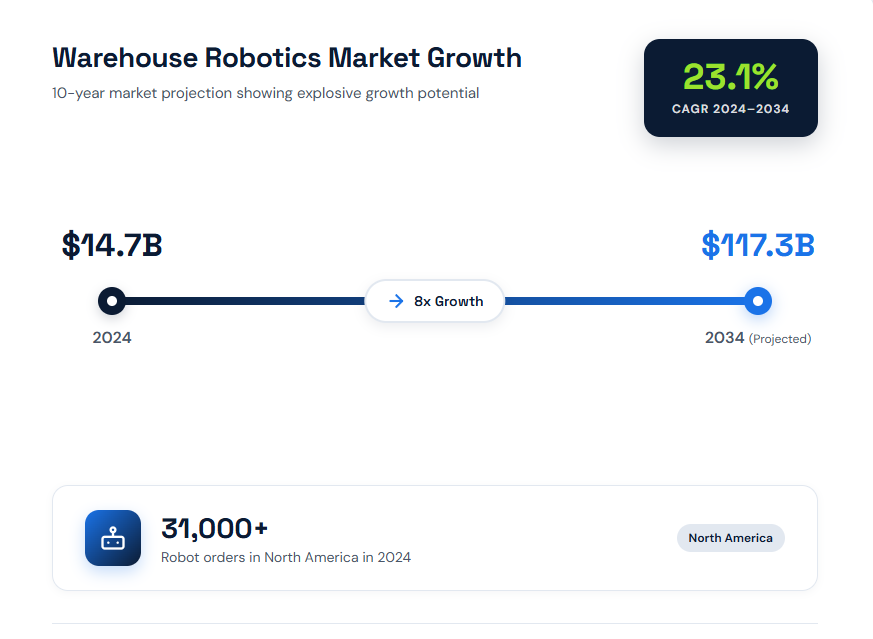
Warehouse automation addresses labor challenges while improving accuracy and throughput. The global warehouse robotics market reached $14.7 billion in 2024 and is projected to grow at a 23.1% annual rate through 2034, according to Global Market Insights. Robots reduce labor minutes per order by up to 60%, allowing facilities to handle volume increases without proportional headcount growth.
Automation options range from basic conveyor systems to autonomous mobile robots (AMRs) and automated storage and retrieval systems (AS/RS). The Association for Advancing Automation reports that North American companies ordered over 31,000 robots in 2024. Start with high-impact areas to improve your warehouse pick rate before expanding automation to other functions.
5. Outsourcing to 3PL Providers
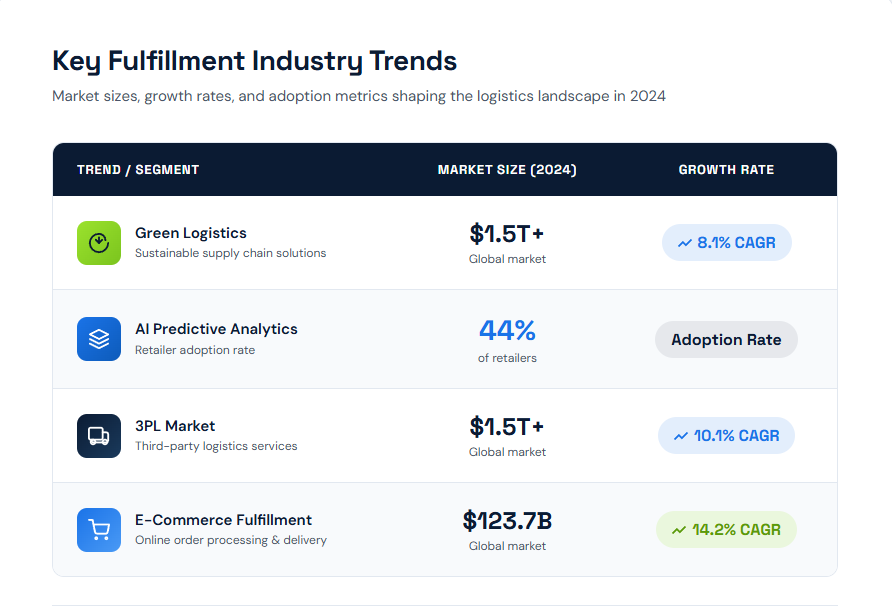
A complete logistics service provider offers a path to scalability without the need for massive capital investment. The global 3PL market exceeded $1.5 trillion in 2024 and is projected to grow at 10.1% annually through 2034, according to GM Insights. Over 90% of Fortune 500 companies now work with 3PL providers, recognizing that logistics expertise often lies outside their core competencies.
A 3PL partnership provides access to established warehouse networks, negotiated carrier rates, and specialized technology without building these capabilities internally. Fast-growing companies particularly benefit when they've outgrown their current warehouse location but aren't ready to invest in owned facilities. The right 3PL can help meet demand and scale up as order volume increases.
Productiv helps businesses achieve fulfillment scalability through flexible 3PL solutions designed for growth. With warehouse networks positioned for rapid delivery and technology integrations that provide real-time visibility, Productiv enables enterprises to scale fulfillment operations without the complexity of building infrastructure from scratch.
5 Trends in Scalable Fulfillment
The fulfillment landscape continues evolving as technology advances and consumer expectations shift. These trends shape how businesses approach scalability in the coming years.
- Omnichannel fulfillment: Consumers expect to buy anywhere and receive products through their preferred channel. This requires integrated inventory management across online stores, marketplaces, and physical retail. Distributed order management systems route orders to the optimal fulfillment location regardless of where the purchase originated.
- Automation and robotics: Investment in warehouse automation accelerates as labor costs rise and technology becomes more accessible. Mobile robots, automated picking systems, and conveyor networks improve throughput while reducing error rates. Third-party logistics providers increasingly embed multi-tenant robot fleets to guarantee high pick accuracy.
- Sustainable practices: Environmental responsibility influences fulfillment decisions. The green logistics market was valued at over $1.5 trillion in 2024 and is projected to grow at 8.1% annually, according to Grand View Research. Businesses adopt recyclable packaging through contract packaging services, optimize routes to reduce emissions, and work with carriers that invest in electric-vehicle fleets.
- Advanced analytics and AI: Machine learning improves demand forecasting, inventory positioning, and route optimization. AI-driven systems analyze patterns to predict peak periods, suggest reorder points, and identify efficiency opportunities. Research indicates 44% of retailers use AI for predictive analytics, and 41% use it for customer analysis and segmentation to inform inventory decisions.
- Micro-fulfillment expansion: Urban micro-fulfillment centers position inventory closer to customers for faster last-mile delivery. These smaller facilities use automation to maximize limited space while reducing delivery distances. The approach addresses both speed expectations and rising real estate costs in metropolitan areas.
Frequently Asked Questions
1. How can businesses prepare for peak season demand?
Preparation includes analyzing historical data to accurately forecast peak volumes, building inventory buffers at strategic locations, and establishing relationships with temporary staffing providers. Technology upgrades should happen before peak season, not during it. Many businesses also expand 3PL capacity during peak demand periods to handle surges without making permanent infrastructure investments.
2. When should a business consider outsourcing to a 3PL?
Businesses typically benefit from 3PL partnerships when order volumes outgrow current warehouse capacity, storage and shipping costs consume excessive margins, or fulfillment complexity increases with multi-channel sales. Companies experiencing rapid growth often find that 3PLs provide faster scaling than building internal capabilities. Over 90% of Fortune 500 companies use 3PL providers.
3. How does automation improve fulfillment scalability?
Automation reduces reliance on manual labor while improving accuracy and throughput. Robots and automated systems can reduce labor minutes per order by up to 60%, allowing facilities to handle volume growth without proportional increases in headcount. Automation also maintains consistent performance during peak periods when hiring temporary workers becomes difficult.
4. What technology is essential for scalable fulfillment?
A cloud-based warehouse management system (WMS) provides the foundation for scalability by offering real-time inventory visibility and automated processes; order management systems (OMS) with distributed order management capabilities route orders efficiently across locations. Integration with carriers, marketplaces, and ERP systems ensures data flows without manual intervention as operations expand.
5. What is distributed inventory, and why does it matter for scaling?
Distributed inventory means spreading stock across multiple fulfillment locations rather than centralizing it in one warehouse. This positions products closer to customers, reducing shipping distances, costs, and delivery times. It also provides redundancy if one location experiences disruptions. Distributed inventory supports scaling by preventing single-point capacity bottlenecks.
Key Takeaways
- Fulfilment scalability means handling growth without proportionally increasing costs or reducing service quality.
- Common scaling challenges include labor shortages, peak-season performance, and the complexity of technology integration.
- Cloud-based WMS and OMS platforms provide the foundation for real-time visibility and automated operations.
- Warehouse automation reduces labor dependency and can cut labor minutes per order by up to 60%.
- 3PL partnerships offer scalability without heavy capital investment—over 90% of Fortune 500 companies use them.
- Distributed inventory strategies position stock closer to customers while providing operational redundancy.
- Sustainability, automation, and AI-driven analytics represent key trends shaping future fulfillment scalability.
20 Years of Kitting Excellence
Ready to Streamline Your Supply Chain?
Join industry leaders achieving 99%+ SLA performance with flexible kitting, fulfillment, and 3PL solutions.
Get in Touch