
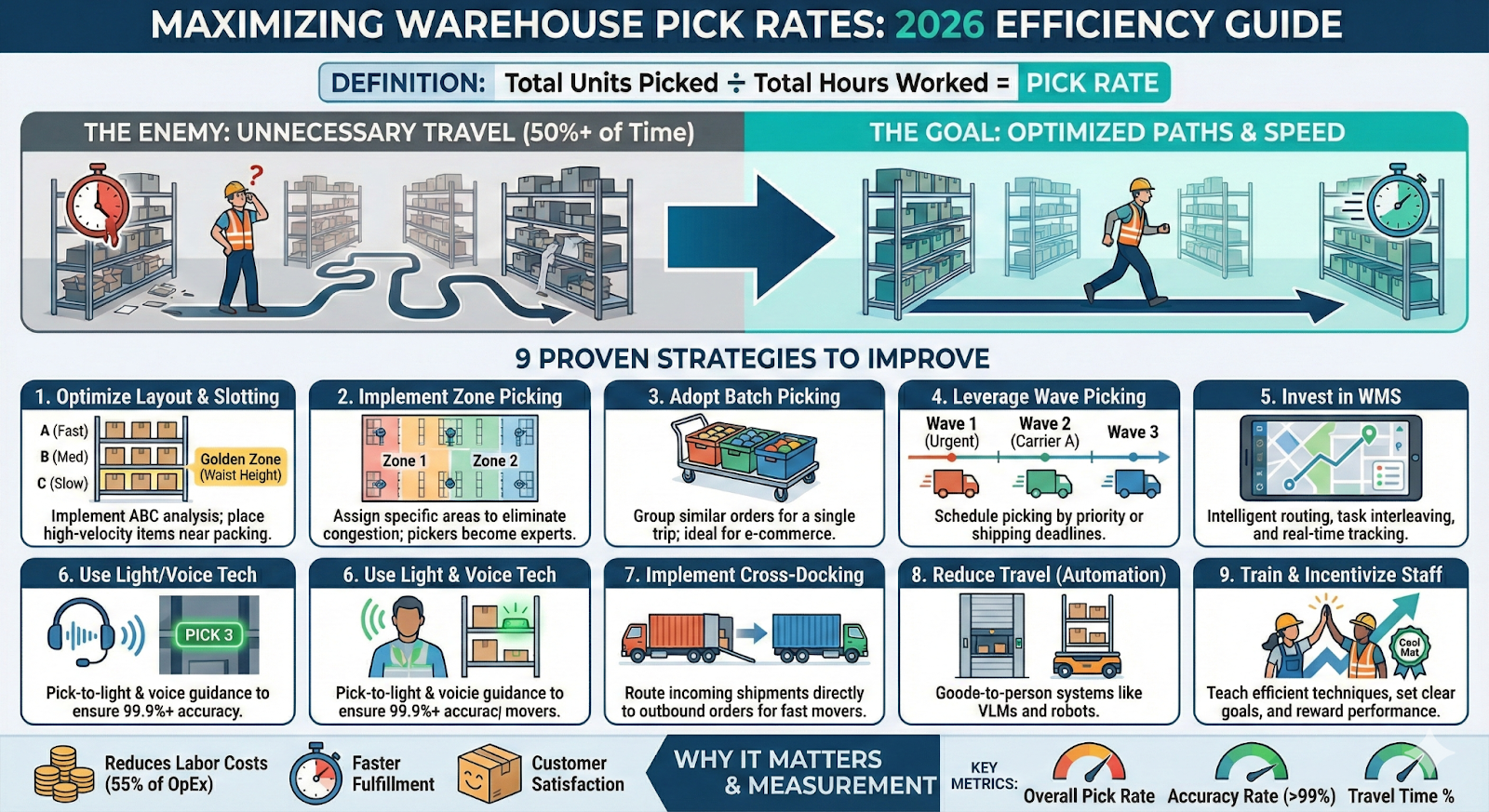
Travel time accounts for 50% or more of total picking time in most warehouses — which means half your labor cost is movement, not productive work. That's the number to attack first, and it doesn't require automation or capital investment to move.
Pick rate is the most direct lever on warehouse labor cost, which represents 55% of total warehouse operating expenses. A 20% improvement in pick rate reduces picking labor cost by 17% — significant savings at any volume.
This guide covers nine proven methods to improve warehouse pick rate, from layout and slotting changes you can implement this week to technology investments that compound gains over time.
What Is the Warehouse Pick Rate?
Warehouse pick rate measures how many items or orders a warehouse worker picks per hour. This metric directly reflects operational efficiency and labor productivity.
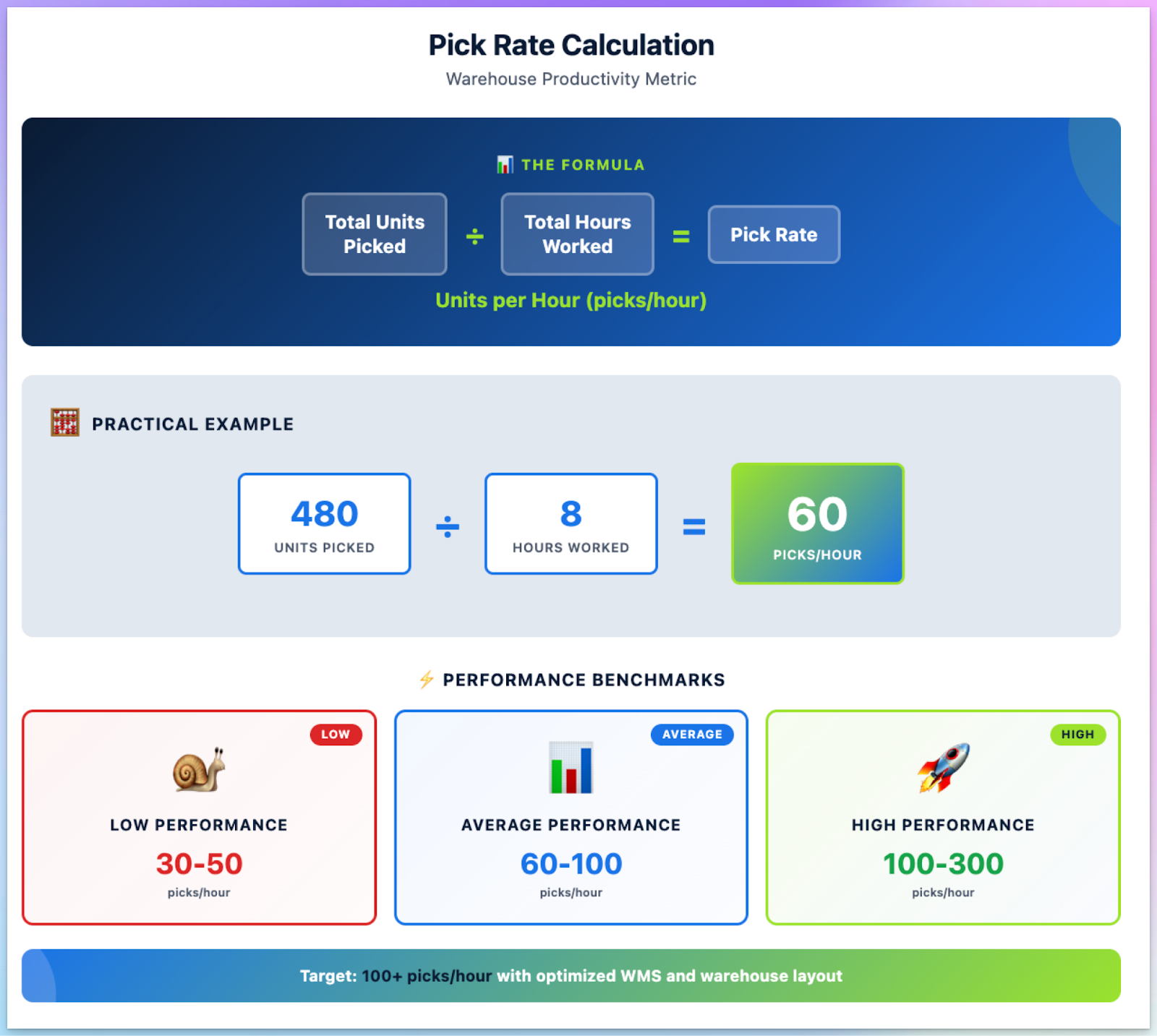
Here’s how to calculate a pick rate: Total Units Picked ÷ Total Hours Worked.
For example, if a worker picks 120 items in a 4-hour shift, their pick rate is 30 picks per hour. Industry benchmarks vary significantly based on warehouse type, product characteristics, and picking method, typically ranging from 60 to 300 picks per hour.
Pack Station Accuracy Rate Benchmarks
Pack station accuracy rate measures the percentage of outbound orders that pass quality verification without errors — wrong item, missing item, or weight discrepancy. It is the companion metric to pick rate: a high pick rate that ships the wrong items costs more than a slower, accurate operation.
| Verification Method | Typical Accuracy Rate | Operation Type |
|---|---|---|
| Manual visual check only | 97.0–98.5% | Low-volume or simple SKU operations |
| Manual pick + barcode scan | 99.0–99.5% | Standard warehouse operations |
| Pick-to-light + scan confirmation | 99.5–99.9% | High-velocity fulfillment centers |
| Scan + weight verification | 99.7–99.9% | Kitting and assembly programs |
| Automated goods-to-person systems | 99.9%+ | High-automation distribution centers |
Operator note: At Productiv, running scan gun verification across kitting programs with 1,000+ SKU movements per day, post-job reconciliation accuracy exceeds 99%. The most common source of accuracy failures isn't operator error — it's vendor concealed shortages that enter the workflow unchecked at receiving. Opening at least one carton per pallet per SKU at inbound catches these before they reach the pack station.
Why Pick Rate Matters for Warehouse Operations
Pick rate directly influences multiple aspects of warehouse performance beyond simple productivity metrics:
- Labor cost control. Picking typically accounts for 55% of total warehouse operating costs, making it the single largest expense category. Higher pick rates mean fewer labor hours required to fulfill the same order volume, directly reducing payroll expenses.
- Competitive advantage. Warehouses with optimized pick rates can offer shorter delivery windows, accept orders later in the day, and handle volume spikes without adding temporary staff.
- Customer satisfaction. Fast, accurate picking enables on-time deliveries. According to the U.S. Census Bureau, e-commerce sales continue to grow year over year, intensifying customer expectations for rapid fulfillment.
- Scalability. Efficient picking processes create capacity for growth without proportional increases in warehouse space or headcount.
9 Proven Strategies to Improve Warehouse Pick Rate
1. Optimize Warehouse Layout and Slotting
Strategic product placement reduces travel time, which accounts for 50% or more of total picking time in traditional warehouses. By organizing products based on velocity, accessibility, and workflow efficiency, warehouses can significantly increase pick speed and reduce worker fatigue.
These are the key layout and slotting strategies that make the most significant impact:
- Implement ABC analysis. Place high-velocity items (A items) in the most accessible locations closest to packing stations. Medium-velocity items (B items) go in secondary zones, while slow-moving products (C items) occupy remote areas.
- Use golden zone placement. Position frequently picked items at waist height (between 30 and 60 inches) to minimize bending and reaching. This ergonomic approach reduces picker fatigue and speeds up retrieval.
- Create family groupings. Cluster products are frequently ordered together in adjacent locations to reduce travel between picks on multi-item orders.
- Reduce aisle congestion. Implement one-way traffic flows and designate fast-pick aisles separate from replenishment routes to prevent picker interference.
2. Implement Zone Picking
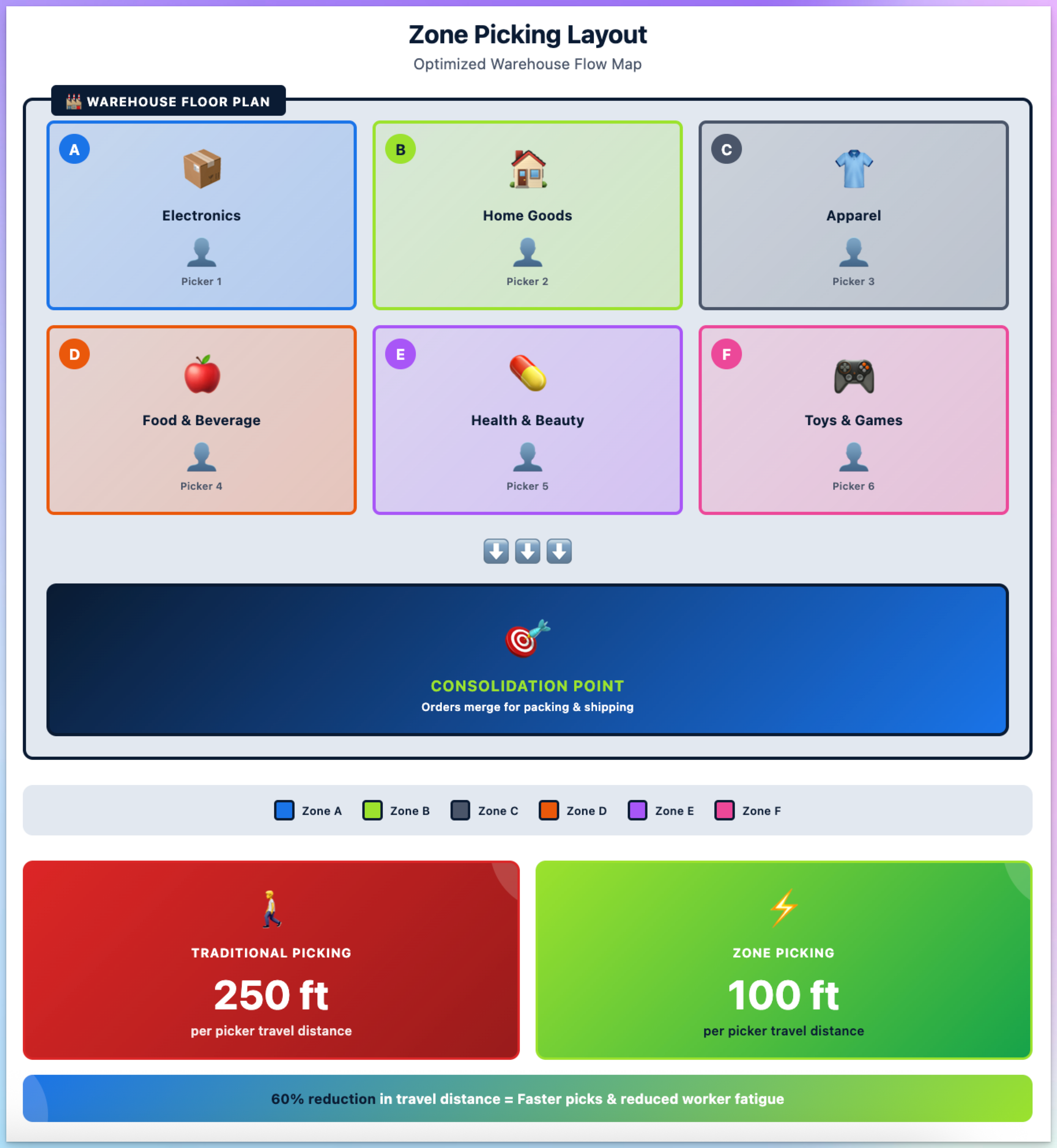
Zone picking assigns specific warehouse areas to individual pickers, eliminating congestion and reducing travel distances.
Each picker becomes an expert in their designated zone, learning product locations and developing efficient picking patterns. Orders requiring items from multiple zones move between pickers or converge at a consolidation point.
Zone picking works best for warehouses with:
- High order volumes
- Multiple SKUs per order
- Clearly defined product categories
- Sufficient order volume to keep all zones busy
This method can increase pick rates by 20-40% compared to discrete order picking while reducing picker travel by up to 60%.
In practice, zone expertise compounds over time beyond the initial travel reduction. When pickers work the same zone consistently, they develop precise familiarity with exact bin locations — the subtle differences between adjacent slots, the tendency of specific SKUs to get misplaced — and start catching inventory discrepancies before they cause a missed pick. That institutional knowledge is where sustained gains come from, not just the shorter travel path.
3. Adopt Batch Picking for Similar Orders
Batch picking groups multiple orders, allowing pickers to collect items for several orders in a single warehouse trip.
A picker retrieves all required quantities of each SKU for the entire batch, then sorts items into individual orders at a consolidation station. This method dramatically reduces travel time for warehouses handling many orders with overlapping SKUs.
These are the main benefits of batch picking:
- Reduces redundant travel to the exact locations
- Increases picks per hour by 30-50%
- Works exceptionally well for e-commerce operations with similar product orders
- Maximizes efficiency during peak periods
Batch picking groups multiple orders so pickers can collect items in a single warehouse trip. After retrieving all required quantities of each SKU for the batch, items are then sorted into individual orders at a consolidation station, significantly reducing travel time and boosting efficiency. The following practices help you maximize the effectiveness of batch picking:
- Group orders with standard SKUs
- Limit batch size to 8-12 orders to prevent sorting complexity
- Use mobile carts with divided compartments for easy order separation
- Implement barcode scanning to avoid errors in sorting
4. Leverage Wave Picking for Time-Sensitive Orders
Wave picking schedules picking activities in coordinated waves based on order priorities, shipping deadlines, or carrier pickup times.
Rather than picking orders as they arrive, warehouses release batches at specific intervals. This allows simultaneous picking across zones, optimized packing schedules, and coordinated shipping.
Implementing the right strategies ensures faster fulfillment and smoother workflow across the warehouse:
- Align picking activities with shipping schedules. Orders are picked in sync with carrier pickup times to reduce delays.
- Prioritize urgent orders. Time-sensitive shipments are handled first without disrupting other workflows.
- Balance workload across shifts. Coordinated waves prevent bottlenecks and distribute tasks evenly among staff.
- Use different wave strategies. Waves can be time-based, carrier-based, priority-based, or zone-based, depending on operational needs.
Wave picking organizes order fulfillment into coordinated waves based on priorities, shipping deadlines, or carrier schedules. By releasing orders in batches at specific times, warehouses can optimize picking across zones while keeping packing and shipping operations aligned.
Common wave strategies include:
- Time-based waves. Orders are released at regular intervals, such as every 2–4 hours, to maintain a steady workflow.
- Carrier-based waves. Picking is organized by specific carriers, such as UPS or FedEx, to ensure timely shipments.
- Priority-based waves. Orders are grouped by urgency, such as same-day, next-day, or standard, so critical orders are handled first.
- Zone-based waves. Different warehouse zones release orders simultaneously for coordinated picking across the facility.
5. Invest in Warehouse Management Systems (WMS)
Modern WMS platforms enhance warehouse picking by using intelligent order routing, real-time inventory tracking, and performance analytics. These methods help increase pick rates, reduce travel time, and improve overall operational efficiency:
- Optimized pick paths. Algorithms calculate the shortest route through the warehouse for each order, minimizing unnecessary travel.
- Real-time inventory accuracy. Accurate stock data prevents wasted time searching for out-of-stock items.
- Task interleaving. Combining picking with putaway tasks eliminates empty travel and maximizes worker productivity.
- Performance tracking. Monitoring workflows identifies bottlenecks and underperforming processes, enabling managers to optimize operations.
- Directed picking. Step-by-step instructions on handheld devices guide workers through each order, enabling faster, more accurate fulfillment.
6. Use Pick-to-Light or Voice Picking Technology
Technology-assisted picking methods eliminate paper pick lists, reduce errors, and help accelerate pick rates. By using visual or auditory guidance, warehouses can improve accuracy while making picking faster and more efficient:
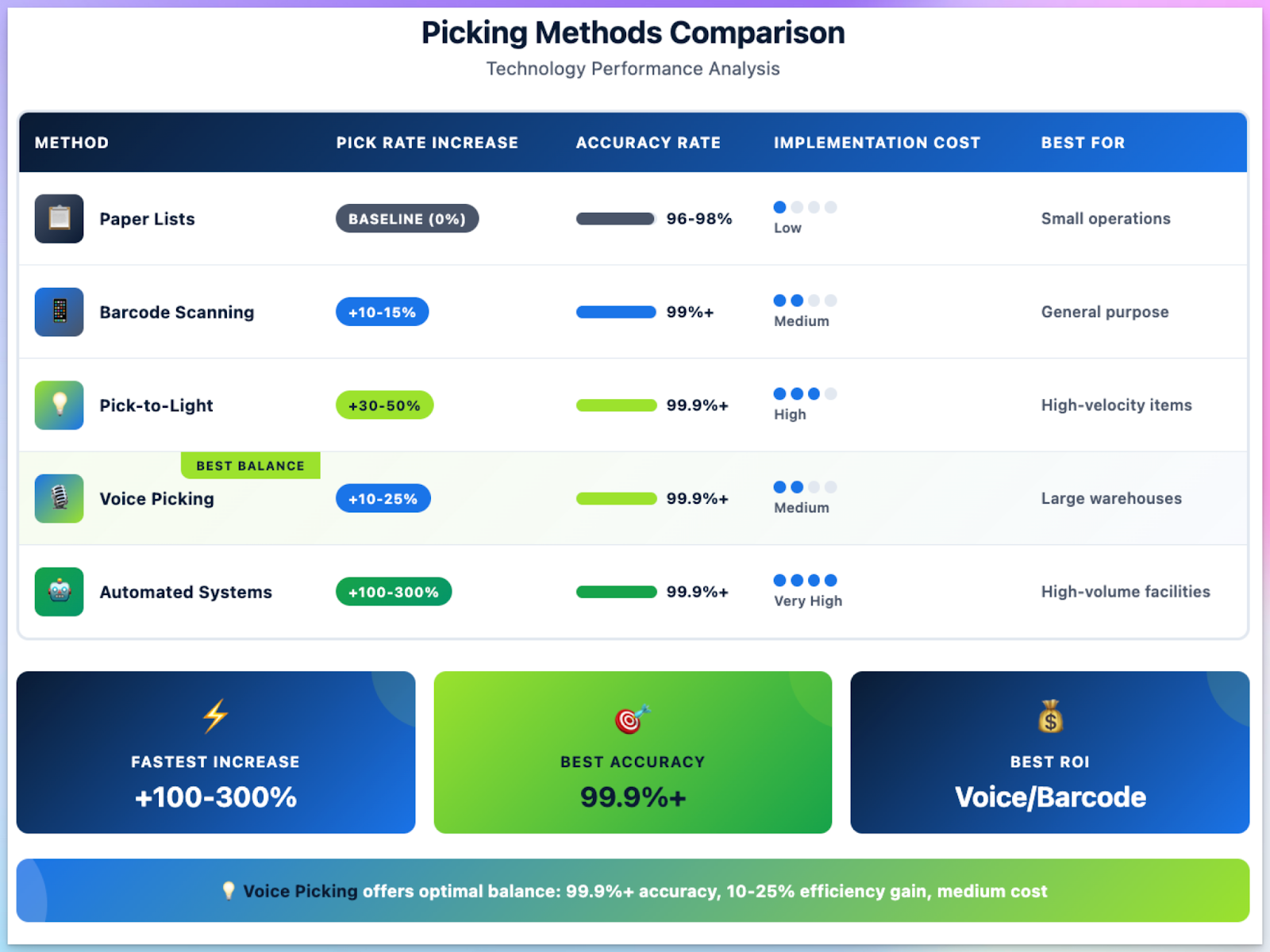
- Pick-to-light systems. LED displays at storage locations illuminate and show the quantity to pick. Pickers press a button to confirm, and the system immediately guides them to the following location, achieving accuracy rates above 99.9% and increasing pick rates by 30–50%, according to the study.
- Voice picking. Workers wear headsets that provide verbal instructions, allowing hands-free operation. Pickers verbally confirm each pick, and the system guides them to the next location, achieving 99.99% accuracy, improving pick rates by 10–25%, and reducing new-employee training time.
One often-overlooked lever is the picking screen UI itself. Streamlining the scan gun interface to remove unnecessary confirmation steps — and configuring auto-advance so the system moves to the next location immediately after a successful scan — eliminates 2–4 seconds per pick without any change to the physical operation. Across 300 picks per shift, that's 10–20 minutes of recovered capacity per worker per day. Combined with a WMS that sequences picks by optimal travel path, UI friction reduction is one of the highest-ROI improvements available before investing in hardware.
7. Implement Cross-Docking for Fast-Moving Items
Cross-docking eliminates storage and picking steps for products that move quickly through your facility by routing incoming shipments directly to outbound orders.
Products arrive at the receiving dock, undergo quality inspection, and are immediately transferred to the shipping dock without entering inventory storage. This approach works best for:
- Pre-sorted items from suppliers
- High-turnover products with predictable demand
- Time-sensitive goods
- Items ordered before arrival at the warehouse
Cross-docking can reduce handling costs by up to 50% for applicable items and can cut order fulfillment time by 24-48 hours. However, it requires sophisticated coordination between inbound and outbound schedules.
8. Reduce Picker Travel Time
Since travel accounts for 50% or more of total picking time, minimizing unnecessary movement delivers immediate improvements in pick rate.
Using automated systems, strategic storage, and optimized layouts helps warehouses move items faster while minimizing picker fatigue:
- Vertical lift modules (VLMs). Automated storage systems bring items to the picker, eliminating travel. VLMs can boost pick rates to 200–400 picks per hour for stored items.
- Goods-to-person systems. Automated mobile robots (AMRs) or conveyors transport inventory directly to stationary picking stations, reducing travel and achieving pick rates of 300+ units per hour.
- Forward pick locations. Keep small quantities of fast-moving items in easily accessible areas near packing stations, replenishing from bulk storage as needed.
- Narrow aisles. Reducing aisle width increases storage density and decreases walking distances, though specialized narrow-aisle equipment is required.
9. Train and Incentivize Warehouse Staff
Even the best systems and layouts depend on well-trained, motivated workers to achieve optimal performance.
Well-trained employees perform tasks accurately and confidently. To build these skills, focus on the following:
- Teach efficient picking techniques and proper equipment use
- Cross-train workers in multiple picking methods and zones
- Provide refresher training quarterly
- Create mentorship programs pairing experienced pickers with new hires
Motivating staff with clear goals and recognition encourages consistent high performance. Effective incentive practices include:
- Set clear, achievable pick rate goals
- Implement tiered bonus structures rewarding consistent high performance
- Recognize top performers publicly
- Track and display real-time performance metrics
Gainsharing programs are one of the most effective incentive structures for pick rate improvement. Tiered hourly bonuses tied directly to pick rate thresholds — for example, $1/hour above 80 picks per hour, $2 above 100, and $3 above 120 — give workers a direct financial stake in their output. The key is setting thresholds that are achievable but require sustained effort. Workers who consistently hit the top tier tend to become informal coaches for newer team members, compounding the program's effect across the floor without additional management overhead.
Comfort and safety are essential for sustained productivity. Key measures to support staff include:
- Provide proper lifting equipment and techniques training
- Ensure adequate lighting throughout the warehouse
- Maintain comfortable temperatures
- Offer supportive footwear allowances
Measuring and Monitoring Pick Rate Performance
Continuous improvement requires systematic measurement and analysis of picking performance. Tracking the right metrics and reviewing results regularly ensures you can identify inefficiencies and optimize operations:
- Overall pick rate. Measure total picks per hour across all picking methods to understand general productivity.
- Pick rate by method. Compare performance between zone, batch, and wave picking to identify the most efficient processes.
- Pick rate by shift. Analyze differences across shifts to detect staffing or training needs.
- Pick the accuracy rate. Track the percentage of picks completed without errors to maintain quality standards.
- Travel time percentage. Monitor the proportion of time spent walking versus actively picking to pinpoint inefficiencies.
- Picks per order. Evaluate order complexity and its impact on overall efficiency.
- Benchmarking. Compare performance against industry standards and establish incremental improvement goals; document baseline metrics before implementing changes to accurately measure ROI.
- Regular reviews. Conduct weekly performance reviews with team leads and monthly comprehensive analyses to identify trends, bottlenecks, and opportunities.
Common Obstacles to Improving Pick Rate
Understanding potential challenges helps you proactively address them during implementation. Recognizing these obstacles early allows you to plan solutions and maintain steady efficiency improvements:
- Inventory inaccuracy. Poor inventory management leads to wasted search time and mispicks. Regular cycle counting and WMS implementation help prevent these issues.
- Insufficient training. Undertrained staff work inefficiently and make more errors. Investing in comprehensive onboarding and ongoing training programs improves performance.
- Poor warehouse organization. Random slotting and cluttered aisles slow pickers down. Systematic reorganization based on product velocity creates immediate improvements.
- Resistance to change. Workers comfortable with existing processes may resist new methods. Involving staff in planning, clearly communicating benefits, and providing transition support helps overcome this challenge.
- Inadequate technology. Outdated systems limit optimization potential. Evaluating technology ROI and phasing in upgrades strategically ensures better results.
- Peak season overload. Volume spikes can expose weaknesses in processes. Planning capacity buffers and temporary staff augmentation in advance helps maintain smooth operations.
FAQ
1. What is a good warehouse pick rate?
A good pick rate varies by operation type, but 60-100 picks per hour represents average performance for manual picking in most warehouses. E-commerce warehouses often target 80-120 picks per hour, while operations using automated systems can achieve 200-400+ picks per hour. Compare your performance against similar operations with comparable product types and order profiles.
2. How much does warehouse pick rate improvement impact costs?
Since labor accounts for 55% of warehouse operating costs, even modest improvements in pick rates generate significant savings. A 20% increase in pick rate effectively reduces picking labor costs by 17%, potentially saving hundreds of thousands of dollars annually for medium- to large-sized operations. Additionally, faster picking enables capacity expansion without facility enlargement.
3. What is the difference between pick rate and pick accuracy?
Pick rate measures quantity—how many items workers pick per hour—while pick accuracy measures quality—the percentage of picks completed without errors. Both metrics matter equally, as high pick rates mean nothing if accuracy suffers. The best warehouses optimize both simultaneously, typically maintaining 99%+ accuracy while improving speed.
4. Can small warehouses improve pick rate without expensive technology?
Absolutely. Layout optimization, slotting improvements, batch picking, and staff training deliver substantial gains in pick rate without significant technology investments. Start with ABC analysis to relocate fast-moving items, implement basic batch picking for similar orders, and train staff on efficient techniques. These foundational improvements often increase pick rates by 20-30% before any technology purchases.
5. How long does it take to improve warehouse pick rate?
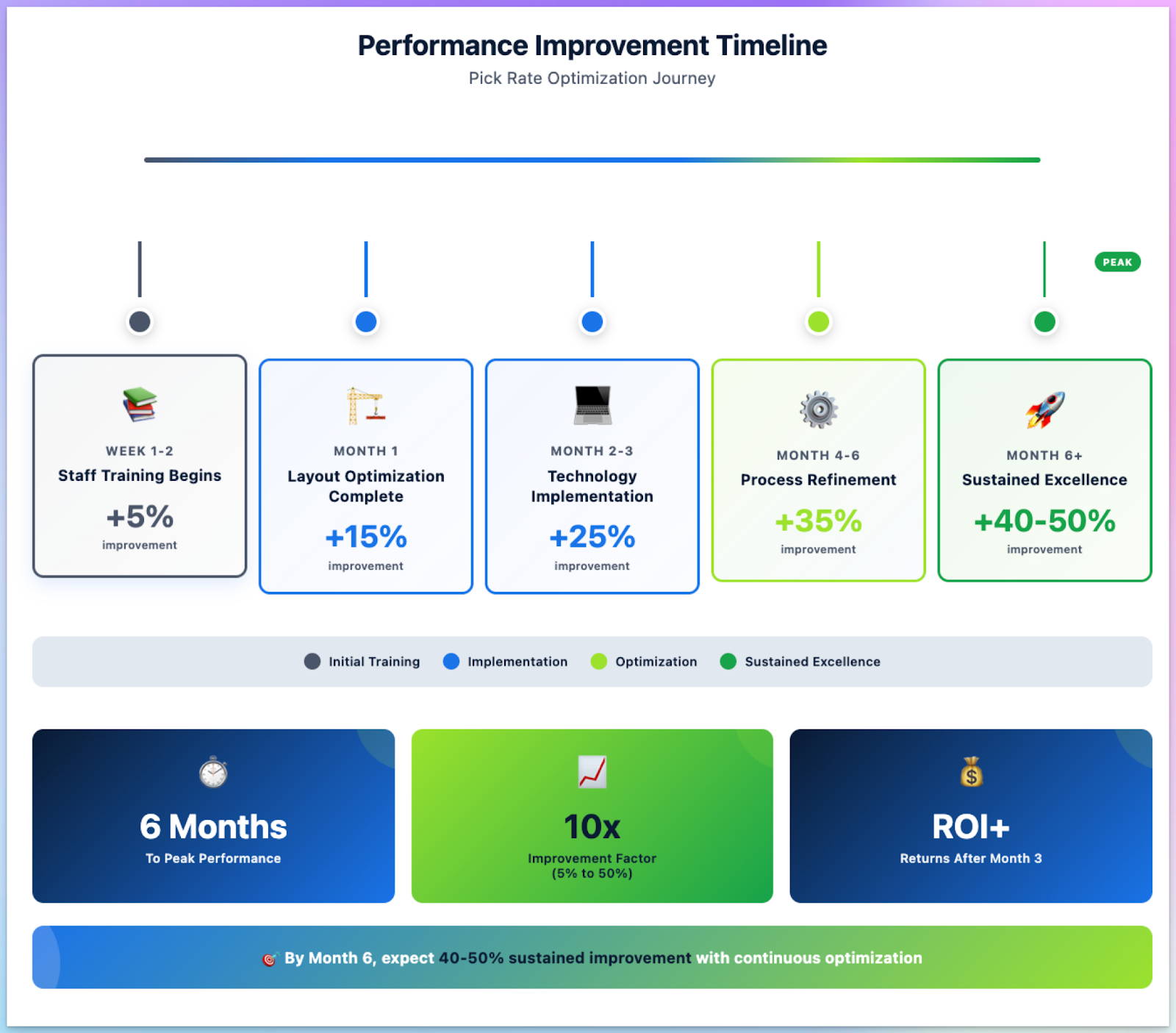
Basic improvements, such as layout optimization and staff training, can yield results within 2-4 weeks. Technology implementations that require WMS integration or automation typically take 3-6 months to deploy and optimize fully. However, you'll see progressive improvements throughout implementation as each element goes live. Most warehouses achieve 30-40% improvements in pick rate within six months using a phased approach.
6. What picking method works best for high-volume operations?
High-volume operations benefit most from wave picking combined with zone picking, supported by WMS technology. This combination allows simultaneous picking across zones while organizing work by shipping deadlines. Adding pick-to-light or voice picking technology in high-velocity zones can further accelerate performance. The specific optimal method depends on your product mix, order profiles, and facility layout.
7. How do I calculate ROI for pick rate improvement projects?
Calculate current picking labor costs (hours × wages) and project savings from improved efficiency. For example, if you currently complete 100,000 picks monthly at 60 picks/hour (1,667 labor hours at $20/hour = $33,340), improving to 80 picks/hour reduces this to 1,250 hours ($25,005), saving $8,335 monthly or $100,020 annually. Compare these savings against implementation costs to determine payback period and ROI.
Key Takeaways
- Travel time comprises 50% or more of total picking time, making layout optimization and slotting the highest-impact improvements most warehouses can implement immediately.
- Zone, batch, and wave picking methods reduce redundant travel and can increase pick rates by 20-50% compared to discrete order picking, with the best method depending on your specific order profiles.
- Technology investments like WMS, pick-to-light, and voice-picking systems deliver measurable improvements of 25-50% while simultaneously increasing accuracy above 99%.
- Improvements in pick rate directly reduce labor costs, which account for 55% of warehouse operating expenses, making optimization efforts highly profitable, with a typical ROI achieved within 6-12 months.
- Comprehensive staff training and performance incentives maximize the effectiveness of any system or layout changes, as engaged workers adapt more quickly and maintain higher productivity.
- Systematic measurement and monitoring of pick rates by method, shift, and worker enables continuous improvement and helps identify specific bottlenecks requiring attention.
- Start with low-cost improvements like ABC slotting and batch picking before investing in expensive automation, as foundational improvements alone can deliver 30-40% gains.
If you're evaluating whether your current operation has the right processes and technology in place, see how Productiv structures fulfillment operations around measurable outcomes — or talk to our team about your specific throughput challenges.
Key Takeaways
- →Travel time accounts for 50% or more of total picking time in most warehouses, which makes layout optimization and slotting the highest-impact improvements available — no automation or capital spend required.
- →Picking labor represents 55% of total warehouse operating costs, so a 20% improvement in pick rate reduces picking labor cost by 17%.
- →Zone picking can increase pick rates by 20–40% and cut picker travel by up to 60%; batch picking raises picks per hour by 30–50% for orders with overlapping SKUs.
- →Pick-to-light systems achieve accuracy above 99.9% while increasing pick rates 30–50%; voice picking reaches 99.99% accuracy with 10–25% gains and shorter new-employee training.
- →Foundational improvements — ABC slotting, batch picking, and staff training — typically deliver 20–30% gains before any technology purchase, and most warehouses achieve 30–40% improvement within six months using a phased approach.
Frequently Asked Questions
What is a good warehouse pick rate per hour?
For manual picking, 60–100 picks per hour is average performance in most warehouses, and e-commerce operations typically target 80–120 picks per hour. Automated systems change the ceiling entirely: vertical lift modules reach 200–400 picks per hour and goods-to-person systems achieve 300+ units per hour. Benchmark against operations with comparable product types and order profiles rather than a single universal number.
How do you calculate warehouse pick rate?
Pick rate is Total Units Picked ÷ Total Hours Worked. For example, a worker who picks 120 items in a 4-hour shift has a pick rate of 30 picks per hour. Industry benchmarks range from 60 to 300 picks per hour depending on warehouse type, product characteristics, and picking method.
How can I improve pick rate without buying automation?
Start with ABC analysis to move fast-moving items into the most accessible locations, implement batch picking for orders with overlapping SKUs, and train staff on efficient picking techniques. These foundational improvements often increase pick rates by 20–30% before any technology purchase. Basic layout and training changes can show results within 2–4 weeks.
Which picking method is fastest — zone, batch, or wave picking?
It depends on your order profile. Zone picking increases pick rates by 20–40% versus discrete order picking and reduces picker travel by up to 60%; batch picking increases picks per hour by 30–50% when orders share SKUs. High-volume operations get the best results from wave picking combined with zone picking, supported by a WMS that sequences work by shipping deadline.
How much does improving pick rate reduce labor costs?
Picking labor accounts for 55% of total warehouse operating costs, so a 20% pick rate improvement effectively reduces picking labor cost by 17%. As a worked example: 100,000 picks per month at 60 picks/hour and $20/hour costs $33,340 in labor; improving to 80 picks/hour cuts that to $25,005 — saving roughly $100,020 annually.
How long does it take to improve warehouse pick rate?
Basic improvements like layout optimization and staff training can show results within 2–4 weeks. Technology implementations involving WMS integration or automation typically take 3–6 months to deploy and fully optimize. Most warehouses achieve 30–40% pick rate improvements within six months using a phased approach that starts with low-cost changes.
Engineered picking operations
Want your fulfillment running at benchmark pick rates — without adding headcount?
Productiv runs scan-verified picking and kitting operations engineered around throughput and accuracy benchmarks. Talk through your pick rate, error rate, and labor cost numbers with an operator.
Talk to an Operations Expert