
Managing warehousing, fulfillment, and shipping in-house drains resources and pulls focus from growth.
Missed deliveries and inventory errors frustrate customers and hurt your bottom line.
Understanding how to choose the right 3PL provider can transform these pain points into competitive advantages.
How to Choose the Right 3PL Provider?
Selecting a third-party logistics provider requires a structured evaluation process that goes beyond comparing price quotes. The following six steps will help you make an informed decision that aligns with your operational needs and growth trajectory.
1. Identify Your Business Objectives
Start by documenting your specific logistics challenges and goals before approaching any provider. Map your current order volume, SKU count, average order value, and fulfillment locations; this baseline data will serve as your evaluation framework when comparing proposals. A 3PL that excels in high-volume B2C fulfillment may not be the right fit for a company with complex B2B distribution requirements.
Consider your 12 to 24-month growth projections and how logistics needs will evolve. According to Armstrong and Associates, 90% of Fortune 500 companies now work with at least one 3PL provider, with larger companies relying most heavily on outsourced logistics to control costs and improve efficiency. Your provider should support your growth trajectory, not constrain it.
 This chart helps readers visualize how to structure their growth planning before approaching 3PL providers.
2. Research 3PL Services
Third-party logistics providers offer varying service portfolios: some focus exclusively on warehousing, others provide transportation management, and some deliver complete supply chain solutions. The 3PL industry serves businesses of all sizes, from small e-commerce retailers to Fortune 500 companies, with each provider typically specializing in specific verticals or order profiles. A provider with deep expertise in apparel fulfillment will have different capabilities than one focused on health and beauty fulfillment or pharmaceutical cold-chain logistics.
Request case studies from providers who work with businesses similar to yours in terms of order volume, product type, and fulfillment complexity. Industry-specific experience matters because it signals familiarity with retail compliance requirements, repack and relabel capabilities, and customer expectations in your sector. Core services to evaluate include receiving and inventory management, pick, pack, and ship fulfillment, kitting and assembly, returns processing, and value-added services such as custom packaging.
3. Understand the Pricing Models
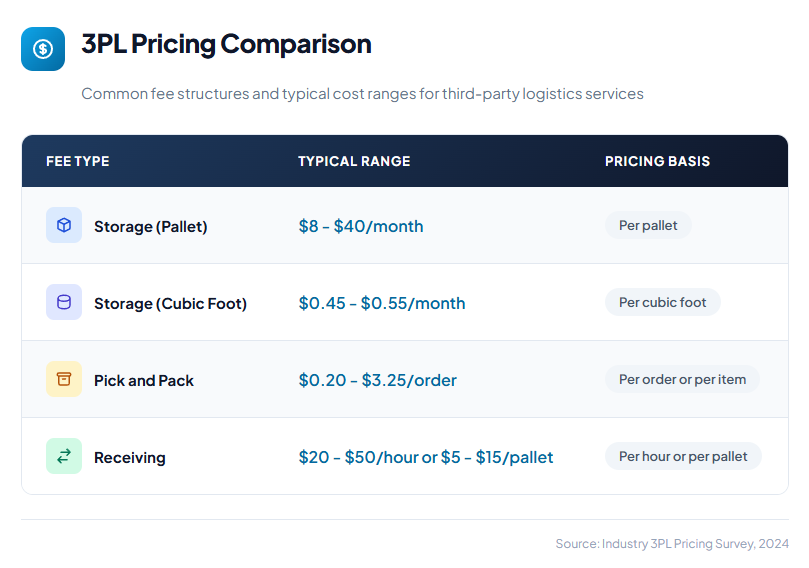
3PL pricing structures vary significantly, and comparing proposals requires understanding the underlying models. Transactional pricing charges for each activity performed: receiving, storage, picking, packing, and shipping. Cost-plus pricing calculates your total fulfillment costs and adds a predetermined markup, on average around 15% of total direct and indirect costs. Fixed-rate pricing offers a flat monthly fee for agreed-upon services, while hybrid models combine elements to meet specific business needs.
Watch for hidden fees that can unexpectedly inflate costs: long-term storage penalties after 30/60/90 days, minimum-volume surcharges, address-correction fees, and account setup charges. Request a detailed rate sheet and ask each provider to model costs using your actual order data from the previous 12 months. This creates an apples-to-apples comparison that reveals the actual cost of each partnership.
4. Evaluate Scalability and Flexibility
Your logistics needs will change with seasonal demands; working with seasonal 3PL services can help manage product launches, market expansion, and channel diversification. The right 3PL partner adapts to these fluctuations without service degradation or painful contract renegotiations. Assess scalability across geographic reach, volume capacity during peak seasons, and the ability to support new fulfillment models like adding B2B wholesale alongside DTC.
Review contract terms carefully since long-term agreements may offer better rates but limit your ability to pivot. The 3PL market is expected to grow at a CAGR of 5.1% to reach $1.48 trillion by 2030, so providers investing in expanded capacity and new facilities signal commitment to growth that benefits their clients, says Mordor Intelligence. Understand termination clauses, minimum commitments, and what happens if your needs change substantially. If you're leaving an existing provider, also factor in the true cost of switching — and staying with — a 3PL before you commit.
5. Assess Delivery Performance Standards
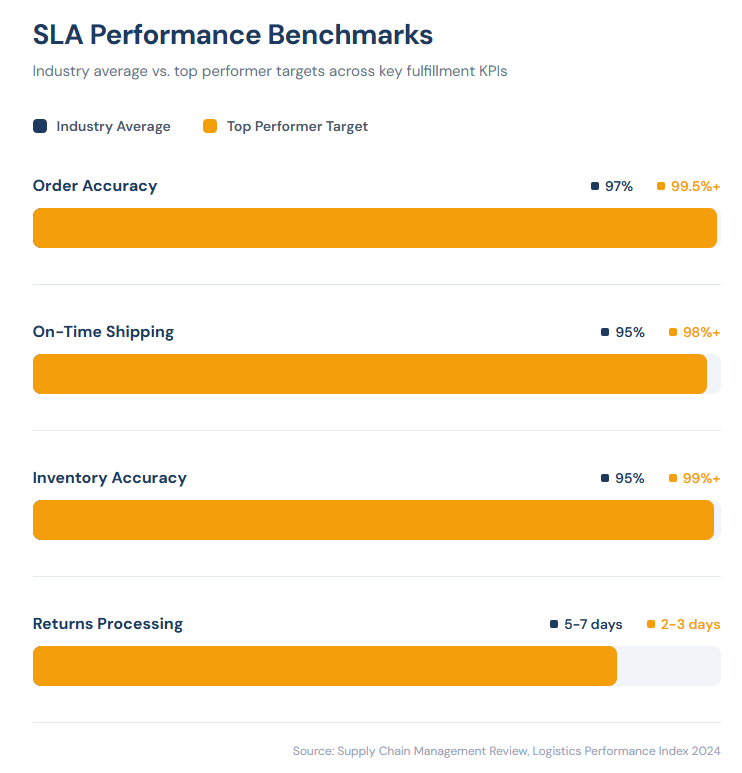
Fulfillment speed and accuracy directly impact customer satisfaction and repeat purchase rates. Define the performance metrics that matter most to your business: order accuracy rate, on-time shipping percentage, inventory accuracy, and returns processing time. Top-tier providers maintain 99%+ order accuracy rates and ship 98%+ of orders within promised timeframes.
Request service level agreements that specify performance targets and penalties for non-compliance. Review the provider's historical performance data against these benchmarks and request references you can contact to verify the claims. Understanding how they handle exceptions and communicate about service issues gives you insight into what the day-to-day partnership will look like.
6. Examine the Provider's Technology Capabilities
Modern 3PL operations run on technology, with a warehouse management system (WMS) as the backbone of fulfillment. The quality and integration capabilities of that system determine how well it serves your business; you need real-time inventory visibility, connections to your ecommerce platforms and marketplaces, and robust supply chain data analytics. Cloud-based WMS platforms provide dashboard access and automated notifications that keep you informed without requiring a support contact.
Ask about native integrations with your tech stack and the availability of your API for custom connections. Advanced warehouse management systems now include artificial intelligence capabilities, predictive analytics, and automation integrations. Ask prospective providers about their technology roadmap and recent platform investments. A provider still running legacy systems may struggle to meet your needs as your business grows and technology requirements evolve.
30M+ Kits Per Year
Put Your Shortlist Side by Side
You have the evaluation process. Now compare providers on pricing model, scalability, technology, and performance in one view.
Compare 3PL Options8 Key Factors to Consider When Choosing a 3PL
Beyond the evaluation process outlined above, several additional factors determine the success of long-term partnerships. Consider these elements when making your final selection to ensure alignment between your needs and the provider's capabilities.
- Industry Experience. A provider with expertise in your vertical understands retailer compliance requirements, customer expectations, and operational nuances specific to your product category. Ask for client references in your industry.
- Financial Stability. Review the provider's financial health, as a 3PL facing cash-flow problems may cut corners on staffing or technology investments, which can directly impact your service quality.
- Communication and Support. Evaluate responsiveness during the sales process, including how quickly they return calls and whether they provide dedicated account management, as these factors often predict the partnership experience.
- References and Reputation. Request references from current clients with similar order profiles and specifically ask about their onboarding experience, issue resolution speed, and overall satisfaction.
- Location Strategy. Fulfillment center locations affect shipping costs and delivery times. According to Grand View Research, the Asia-Pacific region accounted for 42% of the global 3PL market share in 2024, underscoring the importance of strategic geographic positioning for international businesses.
- Disaster Recovery Planning. Ask how the provider protects against disruptions, including backup systems, alternate facilities, and contingency planning. Understanding how they solve supply chain challenges reveals their resilience.
- Cultural Fit. Your 3PL becomes an extension of your brand, so ensure their values around customer service, sustainability, and continuous improvement align with how you want your company represented.
- Onboarding Process. Understand the implementation timeline and requirements, as a structured onboarding process with clear milestones reduces the risk of service disruptions during the transition.
How to Know If You Need a 3PL
Not every business needs a third-party logistics provider. The decision depends on your order volume, operational capabilities, and growth priorities. Use the following framework to determine whether outsourcing fulfillment makes sense for your situation.
If you're handling fewer than 1,000 orders per month and maintaining an accuracy rate above 98%, self-fulfillment likely remains viable. You have the bandwidth to manage logistics internally without sacrificing quality. However, if your accuracy rate falls below that threshold, fulfillment errors are already costing you customers and revenue; it’s a sign that professional logistics support could help.
Businesses processing between 1,000 and 10,000 monthly orders face a more nuanced decision. Consider your primary concern: whether that's reducing costs, improving accuracy, speeding up delivery times, or maintaining brand consistency through custom packaging. If you lack in-house logistics expertise or the technology stack to manage operations at this scale, a standard 3PL partnership fills that gap without requiring massive infrastructure investment.
At 10,000+ orders per month, the question shifts to capital availability. Building your own fulfillment network requires substantial upfront investment in warehouses, staff, and technology. Most businesses at this volume benefit from a complete logistics provider that offers the infrastructure, expertise, and geographic reach needed to scale, without tying up capital that could fuel product development or marketing.
Not all 3PLs are built the same. Legacy enterprise providers (Geodis, GXO), tech-forward platforms (Stord, ShipMonk), and outcome-based operators like Productiv each serve different needs. Productiv, for example, prices on fixed unit cost rather than hourly labor rates and specializes in kitting, assembly, retail compliance, and embedded operations inside client facilities — a model built for manufacturers and brands that need more than storage and ship. See the full side-by-side comparison before you issue your next RFP.
Frequently Asked Questions
What services do 3PL providers typically offer?
Third-party logistics providers handle warehousing, inventory management, order fulfillment, shipping, and returns processing. Many also offer value-added services, including kitting, custom packaging, freight forwarding, and transportation management. The scope of services varies by provider, so match their offerings to your specific operational needs.
How much does working with a 3PL cost?
3PL costs depend on order volume, storage requirements, and service complexity. Storage fees typically range from $15 to $40 per pallet per month, while pick-and-pack fees average $0.20 to $3.25 per order. Request detailed quotes based on your actual order history to get accurate cost projections for your business.
How long does 3PL onboarding take?
Onboarding timelines typically range from 2 to 8 weeks, depending on integration complexity and inventory volume. Simple implementations with standard integrations complete faster, while custom technology connections and large inventory transfers require more time. Ask providers for a detailed implementation plan with milestone dates.
What technology integrations should I expect from a 3PL?
Modern 3PLs integrate with major e-commerce platforms such as Shopify, WooCommerce, and Magento, as well as marketplaces including Amazon and Walmart. They also connect with ERP systems, shipping carriers, and returns management platforms. Confirm your specific integration requirements during the evaluation process.
How do I measure 3PL performance?
Track key metrics including order accuracy rate, on-time shipping percentage, inventory accuracy, and returns processing time. Establish baseline measurements and set improvement targets with your provider. Most 3PLs provide reporting dashboards that display these metrics in real-time for ongoing monitoring.
When should a business consider using a 3PL?
Businesses typically benefit from 3PL partnerships when order volumes exceed internal fulfillment capacity, geographic expansion requires new distribution points, or logistics complexity diverts focus from core operations. The high adoption rate among large companies indicates broad recognition of the strategic value logistics outsourcing provides.
Key Takeaways
- Define your logistics requirements, growth projections, and non-negotiable technology integrations before evaluating providers.
- Carefully compare 3PL pricing models and request cost projections based on your actual order data to ensure accurate comparisons.
- Verify scalability by asking about volume capacity, geographic expansion capabilities, and contract flexibility.
- Establish clear performance benchmarks for order accuracy, on-time shipping, and inventory management with SLA protections.
- Prioritize technology capabilities, including real-time visibility, platform integrations, and reporting tools.
- Check references from clients with similar order profiles and industry requirements.
- Evaluate cultural fit and communication quality during the sales process as predictors of partnership success.
20 Years of Kitting Excellence
Ready to Streamline Your Supply Chain?
Join industry leaders achieving 99%+ SLA performance with flexible kitting, fulfillment, and 3PL solutions.
Get in Touch