Operations should improve over time
Productiv is a 3PL, kitting, fulfillment, and embedded operations company with two decades of experience. We combine enterprise capability with small-company agility to deliver outcomes that compound — not just hold steady.
Founded in 2006. Over 1 million square feet. All under one roof: DTC, B2B for major retailers, kitting, displays, and transportation. One philosophy: engineer it, measure it, improve it.
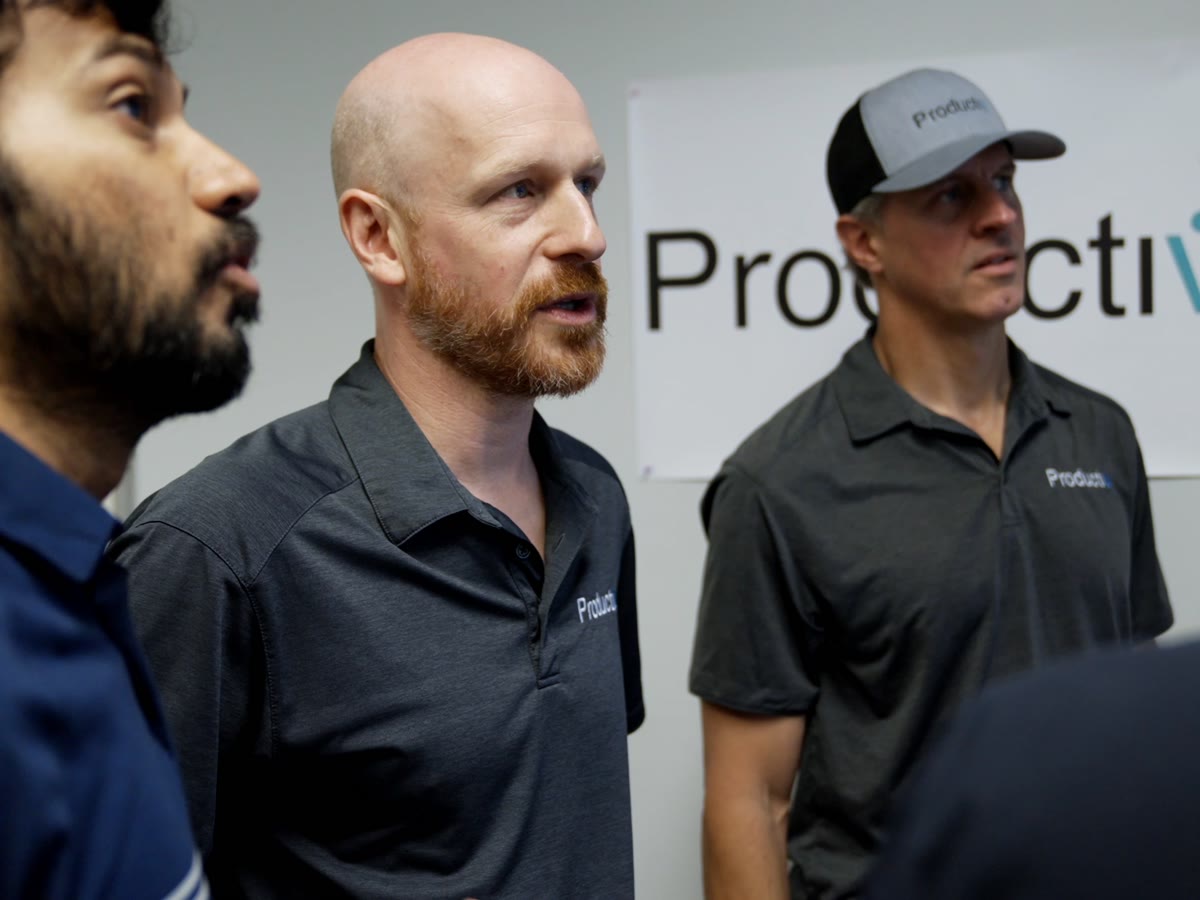
Pulling you forward
Three and a half minutes with Productiv's leadership: the value-add work most 3PLs avoid, how a program is designed around your product before it ships, the robotics and AI on the floor, and the principles that have run the operation since 2006.
Transcript
We don't sell a product. What Productiv is selling is efficiency. So we have to get to know our customers. Oftentimes they have a unique solution that's not easy to automate. Every movement in the warehouse counts. Every 10 feet that a fork truck is driving, every hand movement on a production line — that all counts, and we have to measure it throughout.
People who don't understand fulfillment have never seen a facility in operation. They think that it's moving boxes from point A to point B — it's probably just someone picking, someone putting a label on and getting it out. When they see it in person, they understand it's much more complex.
So we're a third-party logistics company, a 3PL. Our customers are outsourcing a part of, or their entire, supply chain to us. What's different about us in that 3PL industry? It's a really broad term. We really focus on the value-add services: kitting, contract packaging, direct-to-consumer fulfillment. A lot of 3PLs really specialize in what I would say are the simple parts of the supply chain. What we do is a far more unique, often customized solution, where our customers have products that they send us, but we either need to assemble them, label them, package, inspect. There's a value-add service component that's very labor intensive and often really hard to automate.
D2C is more about giving that wow experience to the customer who is receiving the package. B2B is more about getting it right and meeting that compliance — getting that metric, on time in full, to the retailers for further distribution down the lane.
Before we onboard any customer, we try to understand their products, understand their product profile, understand their pain points. So we try to design a program around their requirement. The moment we onboard them, they feel like they found a partner rather than someone just shipping a package or moving boxes.
We have two distinct initiatives. The first is AI and the software piece, and the second is robotics, which we just call physical AI or embodied AI. On the AI side, we feel like we are at the forefront of what's possible today, and we are actively developing and putting those applications into service. We want our team members to be engineering quality and continuous improvement, and we want the robots to be doing the repetitive work.
We're going out with a lean mindset in order to optimize every process, every touch, every activity — eliminate the seven wastes throughout the warehouse or the factory floor. All the work that we're doing is contributing towards getting the work done, which makes us more efficient, which makes our clients happy, which gives us money to share with the workforce. And then, from a servant leadership standpoint, we can go back and say, "Okay, what's next?"
So we're a third-party logistics company. Since I came in in 2017, we've grown over 400%. In that time we've opened five new warehouses and established a ton of new customer relationships. The thing I think I'm really proud about is we have almost zero customer churn through that.
At the scale that we operate, we continue to grow, and we think that offers our customers more and more opportunity — both physical space in the markets they're in, as well as in markets that we continue to grow into — and we are offering customers East Coast, Midwest, and West Coast solutions. So the scale that we offer, both physically and from an IT standpoint, where we are integrated with all major retail brands — you don't see the combination of all those in our industry and our competitors. So we think that human element is always going to be a part of Productiv, but we're augmenting that with a lot of automation that's going to help us scale and protect our customers' brands and quality.
Transcript from the video's caption track, lightly edited for clarity. Words the captions could not resolve are marked [inaudible].
How We Got Here
In 2006, Rich Boehling — a trained nuclear engineer — and Louis Sabetti noticed a pattern. Their manufacturing clients kept hitting the same wall: they needed flexible labor for hand assembly, packaging, and rework, but staffing agencies were sending bodies, not building systems.
So they built something different. Instead of just supplying workers, they designed the workflows those workers would follow — work cell layouts, quality checkpoints, cycle time targets. They treated every client's operation as an engineering problem, not a staffing one.
That approach worked. One early client started Productiv on a single surge line. After the team exceeded throughput and quality metrics, they were given steady-state lines. Then asked to consult on warehouse picking. Then asked to take over the entire warehouse. The pattern repeated across industries: prove it on one line, earn the next.
Today, Productiv operates through two models — a nationwide 3PL network and embedded operations inside client facilities — but the philosophy hasn't changed. Own the process. Measure everything. Improve quarter over quarter.
It extends to the software: the tools that run our floors are built in-house by our own team, a story Lovable published as a customer case study in 2026.
Embedded operations founded
Rich Boehling and Louis Sabetti launched Productiv to solve a pattern they kept seeing: clients needed flexible labor for hand assembly, packaging, and rework — but nobody was engineering the work.
First fulfillment centers open
Clients who originally came to us to improve throughput and reduce labor expense now wanted to recapture floor space. Productiv opened warehouses in Charlotte and Richmond.
Dallas expansion
First move outside the East Coast. Added strategic capacity in Texas to reduce parcel zones and serve brands shipping nationwide.
New leadership takes the helm
Doug Legan and Paul Baker joined to succeed Rich and Louis as the senior managers of the company — bringing a new era of growth and operational discipline.
Retail compliance practice established
Upgraded our WMS and IT stack to support EDI, routing guide compliance, and SLA dashboards — opening the door to major retailer programs.
Nationwide 1M sq ft network
Expanded into the current nationwide network of fulfillment centers spanning Texas, North Carolina, Virginia, Utah, and Nevada.
Cobot & humanoid deployment for kitting
Deployed collaborative robots and humanoid systems to augment kitting operations — increasing throughput while maintaining the flexibility clients depend on.
ProVantage agentic software launches
Launched ProVantage, our agentic software platform that enhances scheduling, quality, and staffing to drive measurable efficiencies for clients.
Enterprise Capability. Small-Company Agility.
Large 3PLs have the scale but not the flexibility. Small providers have the hustle but not the infrastructure. Productiv was built to be both.
Enterprise Resources
- 1M+ sq ft across the US
Strategically positioned facilities that reduce parcel zones, cut transit times, and put us within reach of your customers nationwide.
- Full technology stack
WMS, EDI, API integrations, SLA dashboards, real-time inventory visibility. Not bolted on — built in.
- AI & Robotics expertise
Our ProVantage AI platform, humanoid robot deployments, and cobot integrations bring automation to fulfillment, kitting, and warehouse operations.
- 100+ retail compliance connections
Pre-wired EDI to Walmart, Target, Costco, Amazon, and 90+ others through SPS Commerce.
Small-Company Agility
- Zero bureaucracy
No layers, no ticket systems, no waiting for approvals from people who've never seen your operation. You talk to decision-makers directly.
- Active ownership at every level
Our operators don't wait for instructions — they own outcomes. Problems get solved on the floor, not escalated through committees.
- Decentralized, entrepreneurial operators
Each site runs with the authority to make decisions, adapt to your needs, and move fast. No corporate playbook overriding local judgment.
- Flexibility built in
Seasonal surges, last-minute retailer demands, shifting SKU mixes — we scale up and down without renegotiating contracts or rebidding projects.
Want to understand the structural difference in depth?
Talk to the operators behind this.
No sales team, no gatekeepers — the people who answer are the same people who'll run your operation.
How We Operate
Three principles that shape every decision — from how we price to how we promote. Each one backed by what actually happens, not what a mission statement says.
Lean Principles
A nuclear engineer founded this company. We design work cell layouts, track cycle times, and reduce cost per unit quarter over quarter. One client went from 5,000 units per shift to 25,000 in six months — same facility, same footprint.
Aligned Incentives
We price on a fixed unit cost. That means we earn more by working more efficiently — not by billing more hours. Our teams share in that upside through bonuses tied to quality and throughput, not just attendance.
Servant Leadership
Managers are evaluated by their ability to support and advocate for their teams. Client service is part of everyone's job. When Safeguard Medical needed to relocate operations from New Jersey to North Carolina, the transition ran so smoothly they've had very few issues in over two years.
Want to be part of a team that operates this way?
View Open Positions
The principles, written down.
Productiv CFO and co-owner Paul Baker (Wharton, BS Economics) put two decades of operating this model into a book: Output Over Hours: Paying for What Work Creates. It's the labor economics playbook behind every embedded deployment — why cost-plus contracts cap throughput, how to derive cost per unit, and the operating system that makes output-based labor work.
Written for COOs, VPs of Operations, and GMs at manufacturers where labor is throughput-critical.
SpeakingPaul Baker is speaking at CSCMP EDGE 2026 (Nashville, Oct 6) on “Operators Building Software: From Two-Year Projects to Weekend Tools” — how operations teams build their own production software.
Who We Work With
9 of our top 10 clients are billion-dollar brands and manufacturing companies.
From consumer brands and medical device manufacturers to global cosmetics companies and logistics providers — our clients stay because the operation keeps getting better.
“I have direct access to the key decision-makers, Paul and Doug, and they make decisions quickly. There's not a lot of hierarchy in the organization, so if we need something done, a 10-minute phone call is all it takes.”
John Toler
CEO, Evergreen Enterprises
“They're always treating us like a new customer whether it's the first project or the 8th project. They come to the table with an open concept of 'we're going to make it work', whatever you need.”
Jimmy Cullop
3PL Manager, Orora
“We are hitting all the SLAs over and over again. Productiv has led the charge and brought so many improvements to the table over the last two years.”
Kelli Overson
EVP of Operations, Pourri
“Productiv's customer service is the best I have ever seen, and their leadership in our project made everyone's role easier.”
Steve Ballard
CEO, Ballard Brands
How Working With Us Actually Works
No drawn-out onboarding. No black-box handoff. Here's what the first 90 days look like when you become a client.
Discovery
We review your order data, inventory complexity, SLA requirements, and pain points. Usually a few calls and a facility walk if relevant. Takes 1-2 weeks.
Program Design
We engineer the operating model — workflows, quality systems, technology integrations, pricing structure. Fixed unit cost, aligned incentives. Takes 4-6 weeks.
Onboarding
IT integrations (EDI, API, WMS), inventory receiving, team training, SLA dashboards go live. First orders ship. Takes 6-12 weeks depending on complexity.
Continuous Improvement
This never stops. We track cost per unit, cycle times, error rates, and throughput — then engineer improvements quarter over quarter. That's the whole point.
About Productiv, in brief
Want to see if we're the right fit?
No pitch decks. No pressure. Just a conversation about your operation and whether Productiv makes sense. You'll talk directly with our leadership team — the same people who'll manage your account if we move forward.
Talk to an OperatorResponse within 24 hours. No gatekeepers.