3PL Kitting and Assembly Services: Kits, Bundles, Gift Sets, and Displays
Kitting and assembly is the process of combining individual SKUs into a single, ready-to-ship unit — subscription boxes, retail gift sets, multi-pack bundles, displays, or pre-built product configurations. Bundling is the decision to sell items together; kitting is the physical work that makes the bundle one pickable SKU. A 3PL handles the labor, components, quality control, and shipping under one roof, so brands can launch kitted SKUs without standing up assembly lines or hiring seasonal workers.
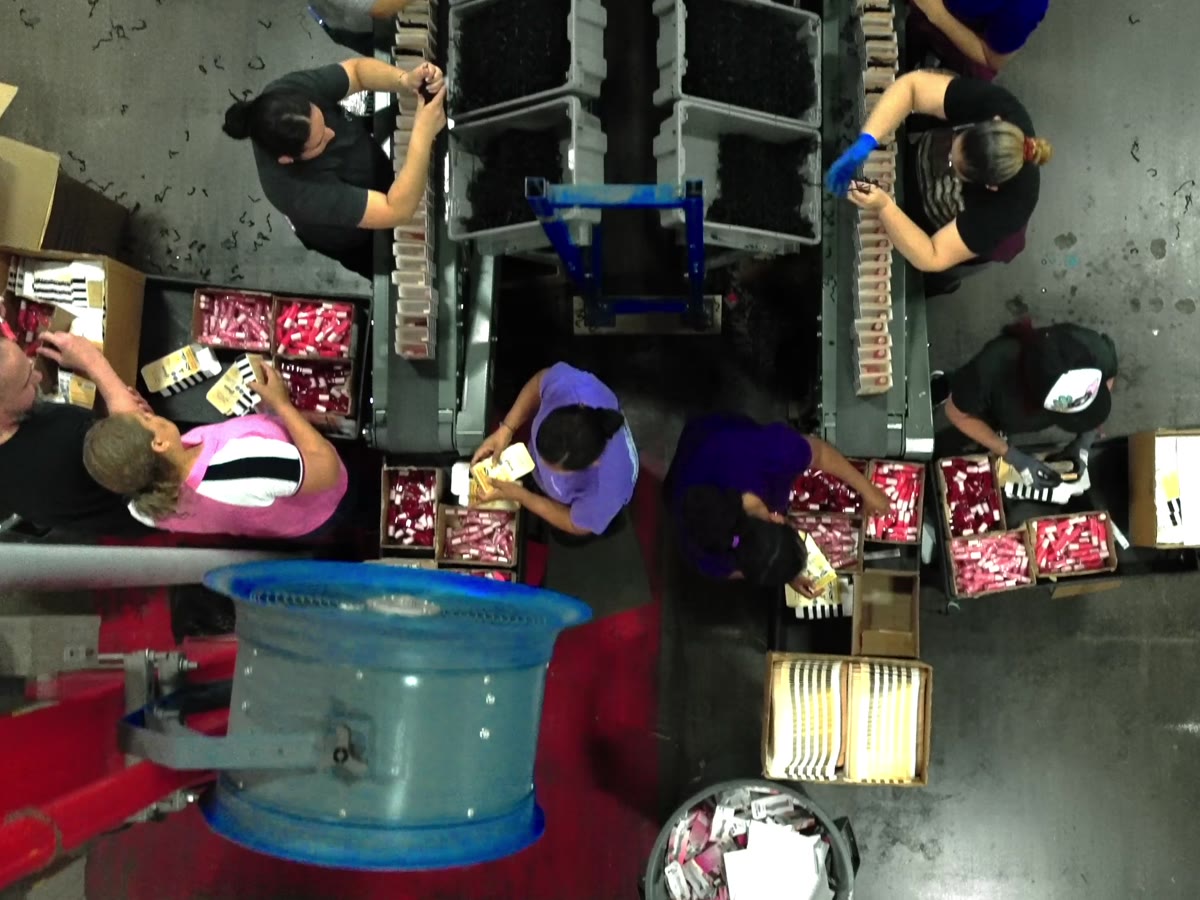
Productiv kits 30 million+ units annually for brands selling through DTC, wholesale, and 100+ retailers, including Walmart, Target, Costco, and Amazon — from one inventory pool. Per-unit pricing, our own trained workforce, retail compliance labeling and ASN/EDI built in. 99%+ SLA.
Based on live program data from Productiv operations — last updated October 2026
Building displays? POP displays, PDQ trays, and endcaps have their own page →
New to kitting? Read our complete guide to what kitting is and how it works → Weighing a bundle against a kit? Jump to kitting vs. bundling ↓
Kits annually
Single programs up to 80,000 kits per day.
Accuracy target
100% for regulated and compliance programs.
trained operators — not temp labor
Line leads average 10+ years tenure.
Program launch
For rework and manufacturing-return programs.
5 U.S. warehouses · experience running 13 cobots + 2 humanoids in live production
Where we kit
Productiv runs kitting and assembly programs from Dallas, the hub of the network, and Charlotte, the East campus. They are where the highest-volume retail, subscription, and gifting programs are built.
Charlotte, NC kitting
Two owned warehouses serving the Mid-Atlantic and Southeast. Charlotte 3PL kitting programs include subscription box assembly, retail gifting, contract packaging, and high-mix industrial kits. Daily kitting throughput across the two sites supports clients with same-region inbound from East Coast manufacturers.
Charlotte kitting and assembly →Dallas 3PL kitting and assembly
Two owned warehouses in Grapevine, TX — the hub of the Productiv network — serving Dallas, Fort Worth, the broader DFW metroplex, and the central United States. Our Dallas 3PL is the highest-volume kitting site, with experience running 13 cobots, 2 humanoid robots, and 1 palletizer alongside human operators. Programs span 20M-unit beauty loyalty, retail gifting, and clean-room medical kitting.
Dallas 3PL: kitting and assembly in Grapevine, TX →Every kitting program type, under one roof
From 200-unit influencer mailers to 20-million-unit annual loyalty programs — we've run them all. The complexity changes. The discipline doesn't.
Subscription Box Kitting
Monthly and seasonal programs with variable SKU configurations, multi-item bundles, and coordinated ship dates. Single programs run 150,000–200,000 kits per month.
Retail Gift Set Assembly
Seasonal gifting programs for major retailers — beauty sets, holiday kits, promotional bundles. One program runs 3–4 million kits per year with monthly configuration changes.
Industrial & Manufacturing Kitting
Parts staging, component kitting for assembly lines, and lot/batch controlled programs. Clean room capability for regulated products including medical devices.
Contract Packaging
Primary and secondary packaging, shrink wrap, retail-ready packaging, co-packing, and display packaging. Often combined with kitting in a single program.
POP Display Assembly
Point-of-purchase floor displays, pallet displays, PDQ trays, and planogram-compliant builds — shipped from the same floor they are built on. The display side of kitting has its own page.
Repack & Relabel
Repackaging, compliance relabeling, rework, and product recovery — inspected, sorted, and repacked into retail-ready cartons on the same floor, priced per unit.
Amazon FBA Prep
FNSKU labeling, poly bagging, bundling, and shipment creation to Amazon fulfillment centers. Compliant with Amazon packaging and prep requirements.
Promotional & Marketing Kits
Influencer mailers, event kits, product launch packages, and sample sets. Variable configurations, personalization, and custom packaging supported.
Contract kitting, custom kitting, subscription box kitting — with fulfillment attached
Buyers call it different things: contract kitting services, custom kitting, fulfillment kitting services, 3PL kitting. The program runs the same way under every name — a bill of materials we own, First Article approval before the run, our own trained operators on the line, and a per-unit price. What changes is how the kit is configured and where it ships.
Contract kitting services
An ongoing program under a per-unit agreement. We own the bill of materials, receive and track every component as it is consumed, run First Article approval before each build, and scale the line's headcount up or down to hold your throughput. Most of the 30M+ kits we build a year run this way.
How contract kitting is priced →Custom kitting services
Variable configurations, personalization, custom inserts and program-based packaging, influencer mailers, launch kits, and sample sets. When the configuration changes monthly or per order, ProQuality routes the First Article photo to your team before the line runs, so an outdated build never ships.
See real custom kit builds →Subscription box kitting
Monthly programs with rotating SKUs and variable inserts, coordinated to a ship date. One subscription program runs 150,000–200,000 kits a month at 30–50 SKUs and 7–10 items per kit — kitted and shipped from the same inventory.
Subscription box fulfillment →Kitting and fulfillment services
The kit is built and shipped from one inventory pool: DTC orders as branded parcels, wholesale as case packs, retail POs against the routing guide with GS1-128 labels and EDI 856 ASNs. No transfer to a second vendor, no re-count, no second invoice.
DTC fulfillment from the same floor →Kitting vs. bundling: what's the difference, and when does a bundle need to become a kit?
Bundling is a merchandising decision. Kitting is a physical operation. The terms get used interchangeably in e-commerce, which causes real problems, because the choice between them determines your inventory model, your cost per order, and what your customer actually finds in the box. Most brands start with bundling because it's free to try, and grow into kitting when volume, presentation, or a retail program forces the issue.
What is bundling?
A sales and pricing strategy: two or more products sold together at a combined price, created in your e-commerce platform as a product page, a cart rule, or a discount. A marketing team can launch one in an afternoon. Critically, a bundle doesn't have to change anything physical. When a customer orders a "complete routine" bundle of cleanser, moisturizer, and serum, the warehouse picks three items from three bins and packs them into one shipment, or several. The bundle exists at the pricing layer, not the inventory layer. That is its strength — zero setup cost, kill it tomorrow if it doesn't sell — and its ceiling.
What is kitting?
The physical operation of gathering multiple SKUs into one new sellable unit that gets its own SKU, its own bin, and its own inventory count. The kit is built before the order arrives, so when a customer buys it the warehouse picks one thing, not three. The output is a deliberate product: right-sized packaging, items arranged the way the brand intended, one label, one scan. Kitting is a production activity with real per-unit economics and real quality standards, which is why it's usually where a specialist partner enters the picture.
Virtual bundles vs. physical kits on Amazon
Amazon makes the distinction concrete because it offers both. Virtual Product Bundles let Brand Registered sellers combine existing FBA ASINs on one detail page with no physical prep; components pick from existing FBA stock and can arrive in separate boxes on different days. Physical bundles are a new ASIN that must exist as one sellable unit before it reaches FBA — kitted, labeled "sold as set," one scannable barcode — and that prep happens upstream of Amazon's warehouse, at your facility or through our Amazon FBA prep operation.
The decision logic maps cleanly: virtual bundles are for testing demand with zero commitment; physical kits are for when the set is the product — gift sets, multi-packs, curated collections — and arriving as three loose items would undermine it.
The inventory question: new SKU or bill of materials?
A virtual bundle leaves inventory untouched: component SKUs keep their counts and each sale decrements them directly. A physical kit creates a new SKU governed by a bill of materials. When 5,000 kits are built, each component drops by 5,000 times its quantity per kit and a finished-kit count appears.
That changes three things: forecasting happens at two levels, component supply and kit demand; allocation matters, because components reserved for kit production can't also be promised for individual sale; and cycle counting covers both loose components and finished kits. None of it is hard with a WMS that handles kit SKUs and BOMs properly — but it has to be set up deliberately, and it's the part brands most often discover mid-program.
Four triggers that turn a bundle into a kit
Volume. A three-item bundle picked as three items carries three picks, three verification points, and often split or oversized packaging on every order. At low volume that's noise; at hundreds of orders a day it's a measurable line item. Pre-building the kit converts three picks into one.
Gifting and presentation. When the unboxing is part of the product — gift sets, premium collections, influencer mailers — items arriving loose in a poly bag is a brand failure. Physical kitting is the only way to control what the customer actually opens.
Retail programs. The moment a retailer takes your bundle, it must become a kit: one scannable unit with its own barcode, retail-ready packaging, and routing-guide-compliant labeling. There is no virtual bundle on a store shelf.
Peak throughput. In Q4, a pre-built kit ships as fast as any single-SKU order. Multi-line orders are exactly what slows a pick operation down when volume triples.
The pattern across all four: bundling optimizes for flexibility, kitting optimizes for the order moment. When the order moment starts carrying the cost — in labor, in shipping, in presentation, in retail compliance — the program is telling you it's time to kit. Subscription boxes skip the question entirely: the curated physical box is the product, which is why subscription box fulfillment runs closer to a production program than to standard e-commerce. And if your set involves actually building something — displays, carded packaging, components combined into a finished product — that's assembly, not kitting; we draw that boundary in kitting vs. assembly.
// THE_COST_MATH
The bundle-to-kit decision is modelable
Kitting is a known per-unit quantity: $0.04–$0.08 per item placed plus a $0.25–$0.75 base kit fee, so a 10-item mid-complexity kit prices at $0.65–$1.05 all-in. Put that against what the virtual bundle costs you per order — the incremental picks, the split-shipment or oversized-carton freight, the error rate on multi-line orders, and the AOV a properly presented set commands. For a three-to-five item set at meaningful volume, the kitting fee is frequently smaller than the shipping variance alone.
Run the numbers before peak, not during it. Bring us the bundle and the volume and we'll model the per-unit math with you.
How 3PL kitting and assembly works
Six stages, repeated across every program. The discipline is what catches errors before they reach the retailer.
- 01
Inbound receiving and inspection
Components arrive and are verified against the bill of materials. At least one carton is opened per pallet per SKU to catch vendor concealed shortages before production begins — the most common source of inventory error in kitting operations.
- 02
Inventory slotting and work cell setup
Components are positioned in the work cell to minimize pick travel and maximize throughput. High-velocity components go in the golden zone (waist height, arm's reach). Scan gun configurations are built per program before the line starts.
- 03
Pick and kit with scan verification
Operators pull components per the bill of materials and assemble the finished unit. Scan gun verification at each pick maintains inventory accuracy above 99% across programs running 1,000+ SKU movements per day.
- 04
Quality inspection
Barcode verification, weight check, and photo documentation confirm accuracy at the unit level. Units that fail inspection are pulled and reworked before moving to labeling. This step prevents compliance failures from reaching the retailer.
- 05
Compliance labeling
Retailer-specific labels, UCC-128 case labels, and GS1 barcodes are applied per retailer specification. Productiv is pre-wired for Walmart, Target, Costco, and 30+ other retail partners — labeling specs are maintained in the WMS and applied automatically per program.
- 06
Pack out, ASN transmission, and post-job reconciliation
Finished kits are packed and sealed. The EDI 856 ASN is transmitted to the retailer within the required window. Extras, shorts, and damages are documented and reconciled in the WMS before the job closes — preventing the chargeback-triggering discrepancies that happen when inventory records don't match physical shipments.
Built for major retail compliance
Productiv kits and ships into Walmart, Target, Costco, Amazon, Sephora, and 30+ other retail partners. Every program includes retailer-specific labeling, ASN transmission, and chargeback prevention built into the workflow — not bolted on after the fact.
Retailer Requirements Review
We map every retailer's routing guide, labeling specs, and EDI requirements before the first unit is kitted.
GS1 Labeling & UCC-128
UPC/GTIN compliance, case labels, pallet labels, and GS1 barcodes applied per retailer specification.
ASN & EDI Transmission
Advance Ship Notices sent via EDI 856, with SPS Commerce integration covering all major retail EDI requirements.
Chargeback Prevention
Built-in verification at each stage catches compliance issues before they leave the building — not after the chargeback arrives.
Retailer onboarding, EDI connections, and chargeback prevention in depth: Major retailer EDI & compliance →
One kitting operation for every channel you sell through
Every 3PL says end-to-end. Then kitting gets treated as storage plus picks, the holiday sets slip the retailer's window, and the display program quietly goes to a co-packer anyway. The channels that make a consumer brand grow are the work generalists are worst at.
We run all of it — DTC bundles and gift-with-purchase, wholesale multi-packs, retail gift sets and displays — from the same buildings, the same inventory pool, and the same account team. The same components become a DTC kit today and a planogram-compliant PDQ next week, without a second vendor in the chain.
Kitted bundles, gift-with-purchase, launch kits, and subscription boxes.
Right-sized branded packaging, inserts and personalization, kit SKUs that ship same-day from the same inventory that feeds your retail POs.
DTC fulfillment →Multi-packs, case-packed sets, and pre-assembled dealer or salon kits.
GS1 case and pallet labels, inner-pack configurations per account, and component-level inventory so kit builds never strand stock you promised elsewhere.
B2B distribution →Holiday gift sets, seasonal programs, PDQ trays, and floor displays built to planogram.
Retailer-specific labeling, EDI 856 ASNs, and production planned against the reset date and cancel date. Our error, our credit — with the root cause fixed.
POP displays & PDQs →// PATTERN_PROOF
3M+ holiday cosmetic kits a year for a major cosmetic retailer program. Two growth-stage skincare brands moved their retail and D2C operations to us in the same week. Beauty and personal care is where the kitting-across-channels pattern shows up most — holiday sets, GWP, sampling programs, and retail displays running off one component pool.
Beauty & personal care 3PL: kitting, compliance, and fulfillment for every channel →// HOW_IT_RUNS
The difference isn't the warehouse. It's the team running your program: a long-tenured account coordinator sitting in the warehouse next to your product, a named director as backup, production planned against launch dates and ship windows, and a weekly SLA call that covers every channel at once.
How the Managed Account Program runs your kitting program →20 years of solved kitting problems
Most kitting problems aren't new. Vendor concealed shortages, First Article mismatches, lot control gaps, count discrepancies on program transfers — we've seen all of them, solved all of them, and built tools to prevent them from recurring.
When you start a program with Productiv, you're not paying for us to learn your industry. You're inheriting 20 years of solved problems.
"We are hitting all the SLAs over and over again. Productiv has led the charge and brought so many improvements to the table over the last two years. There's nothing glaring that stands out anymore and now we are just fine tuning."
Kelli Overson, EVP of Operations — Pourri
Our own trained operators. Not temp labor.
Every operator on your program is our own trained Productiv operator — not temp labor. Line leads, supervisors, and account coordinators average 10+ years of tenure. The institutional knowledge stays on your program — not cycling through every 90 days.
ProQuality — First Article before every run.
Our operator-built AI quality tool auto-routes First Article photos to your team for approval before the full run begins. The most common source of kitting errors — incorrect configuration approved verbally but not validated — is eliminated at the start.
Per-unit pricing. No hourly billing.
You pay per kit, not per hour. That means our incentive is to build kits faster and more accurately — not to bill more time. Efficiency gains flow to you as lower cost per unit, not to us as margin padding.
Robotics experience on live kitting lines.
We have experience running 13 cobots, 2 humanoid robots, and 1 palletizing robot alongside human operators on kitting lines at our Dallas facility, with robot pick accuracy reaching 99%+ on validated SKUs. That experience informs how every kitting line is engineered.
Programs we've run
Real programs. Real numbers. Anonymized where required.
Major beauty brand — loyalty program
20 million kits per year. 5 SKU varieties. 1,000+ units per hour across multiple lines. Monthly configuration changes managed without line stoppages.
Major beauty brand — seasonal gifting
3–4 million kits per year. 15–18 items per kit. 100,000+ kits per day at peak. 3-second takt time per item. Retail launch dates held without exception.
Subscription fishing and tackle program
150,000–200,000 kits per month. 30–50 SKUs per kit. 7–10 items per kit. Running at 720 units per minute with cobot and humanoid robot augmentation.
Outdoor safety brand — first aid kits
Up to 100 items per kit. Lot and batch control across 75 regulated items. Regulatory documentation per job. 100% accuracy requirement maintained.
FEMA disaster relief — meal program
2.7 million meals packed in 2 weeks. Procurement and sourcing included. Zero lead time — program stood up within 48 hours of contract.
Medical device manufacturer — surgical trays
Clean room kitting with full lot traceability. Expanded scope from kitting into upstream picking after identifying missing components as root cause of line stoppages. Throughput improved significantly.
"We chose Productiv because of the convenience of being flexible. Most kitting partners are not as flexible as Productiv."
Jeremy Lockhart, Director of Operations, Southeast — Orora Landsberg
"We get a lot of requests from large retailers. Productiv's willingness to accommodate work from us and have awesome communication is really what makes them a head above other people we've talked to."
Chuck Springer, Procurement Manager — Buzzy Seeds
“They are best in class for kitting”
“…the on-time delivery of kitting jobs has improved significantly compared to our previous provider, with a noticeable reduction in scrap”
“Productiv is a very experienced kitter. The fact that they are familiar with the beauty industry…”
“Their pricing was significantly better than the competition. Highly recommend as a kitting partner.”
Per-unit pricing. Transparent from day one.
Productiv prices kitting on a per-unit basis. No hourly billing, no hidden fees, no line-item engineering charges. The pricing model aligns our incentives with yours: we earn more by working more efficiently, not by billing more hours.
// RATE_STRUCTURE
Base fee driven by lot/batch control, special labeling, packaging type, and required accuracy tolerance. See full pricing breakdown →
What affects your per-unit rate
Related reading
POP Displays & PDQs
Point-of-purchase floor displays, PDQ trays, and planogram-compliant builds for seasonal retail resets.
// PILLARWhat is kitting?
A complete guide to kitting in logistics: definition, types, costs, and when to outsource.
// BUYER_GUIDEChoosing a 3PL for kitting and assembly
What to evaluate when picking a kitting partner: capacity, accuracy, retail compliance, and onboarding speed.
// SOLUTIONSubscription box fulfillment
Subscription-specific kitting: monthly variable SKUs, coordinated ship dates, 150K+/month programs.
// COMPARISONKitting vs. assembly
The operational and pricing differences between the two — and when a program needs both.
// INDUSTRYBeauty & personal care 3PL
Holiday sets, GWP, sampling, and retail displays for beauty brands selling through DTC, wholesale, and major retail.
// PROGRAMKit Connect
Productiv's kitting and contract packaging program — see real kit builds and program photography.
// SOLUTIONContract packaging services
Shrink wrap, retail-ready packaging, and co-packing — the packaging layer that runs alongside kitting, priced per unit.
Heading into Q4? Kit configurations, components, and packaging need to be locked by August — start with the peak season fulfillment readiness guide.
Kitting questions, answered
Everything buyers ask us before starting a kitting program.
Tell us about your kitting program.
Whether you're launching a new program or moving an existing one, we'll tell you honestly what we can do and what it would cost. No pitch decks. No pressure.