
When fulfillment slows down, everything suffers: margins shrink, customers lose patience, and competitors gain ground.
With 2-3-day delivery now the baseline expectation, warehouses running on outdated processes are feeling the pressure more than ever.
Luckily, streamlining fulfillment processes doesn't require a complete overhaul.
This guide breaks down nine practical strategies that lead to measurable improvements without disrupting your entire operation.
What Is Supply Chain Management?
Supply chain management (SCM) encompasses the end-to-end coordination of product flow from raw materials to final delivery. It covers sourcing, procurement, manufacturing, warehousing, inventory control, and distribution.
Within SCM, fulfillment operations represent the critical "last mile" that directly affects customer experience. These operations include receiving inventory, storing products, processing orders, picking and packing items, and shipping to end consumers.
The fulfillment segment of supply chain management has become a competitive differentiator. Companies that execute this phase well can process orders faster, reduce errors, and maintain healthy profit margins while meeting delivery expectations.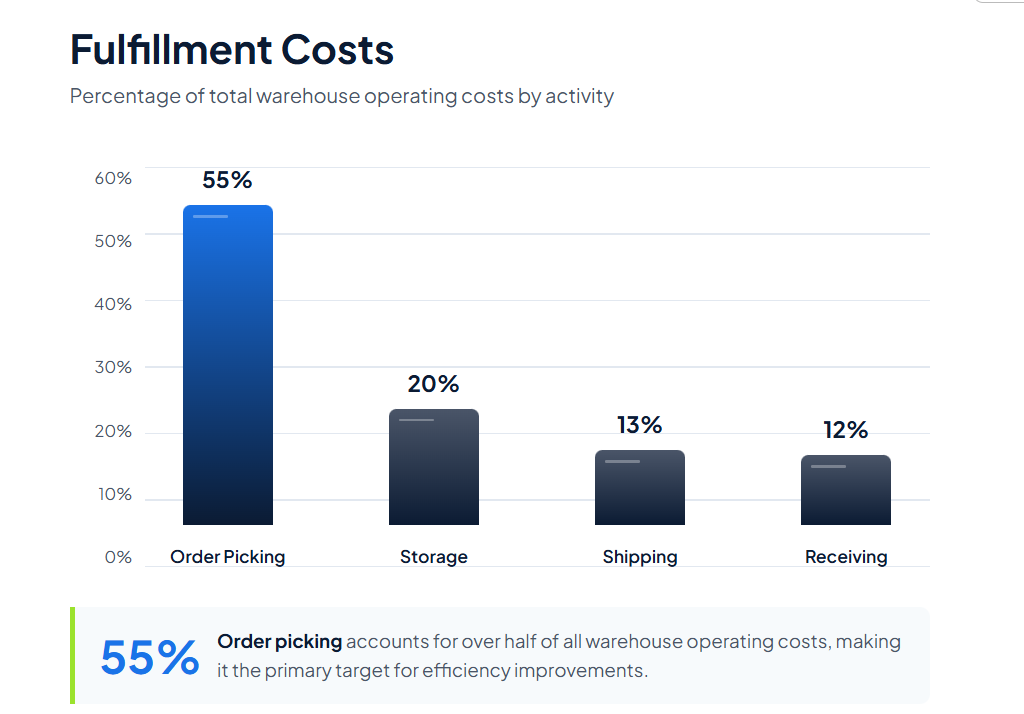
6 Risks of Supply Chain Mismanagement
Poor supply chain practices create cascading problems that affect every business metric. According to Resilinc, supply chain disruptions increased 38% year over year in 2024, with factory fires, extreme weather events, and regulatory changes topping the list of incidents.
Understanding supply chain challenges is the first step toward solving them. Here are the primary risks organizations face when fulfillment processes fall short.
- Revenue loss from stockouts. When inventory records don't match physical stock levels, customers experience out-of-stock products. The global retail industry loses an estimated $1.7 trillion annually due to stockouts, according to IHL Group. Customers who can't find products often purchase from competitors and may not return.
- Excess carrying costs. Overstocking ties up capital and increases storage expenses. Carrying costs for excess inventory typically range from 15% to 30% of product value annually. A 5% overstock rate in a $1M warehouse equals $50,000 in wasted capital plus ongoing holding fees.
- Order accuracy failures. Picking errors lead to returns, refunds, and repeat shipping costs. The average picking error rate ranges from 1% to 3%, costing $50 to $300 per incident in direct expenses (excluding customer relationship damage).
- Delivery delays. According to McKinsey, 90% of customers are willing to wait 2 to 3 days for delivery, but they rank on-time arrival as more important than speed. Late deliveries erode trust faster than slow deliveries.
- Operational inefficiency. Disorganized warehouses increase labor costs through wasted travel time and extended pick cycles. Order picking accounts for up to 55% of warehouse operating costs, making inefficient processes particularly expensive.
- Customer churn. Poor fulfillment experiences drive customers away permanently. Research shows 63% of consumers will choose a different retailer for future purchases if shipping takes longer than expected.
9 Key Fulfillment Process Streamlining Strategies
1. Implement a Warehouse Management System
A warehouse management system (WMS) serves as the operational backbone for modern fulfillment. These platforms track inventory in real time, generate optimized pick lists, and coordinate all warehouse activities from a central interface.
WMS technology reduces errors by validating barcodes at each process step. When pickers scan items, the system confirms accuracy before allowing them to proceed. This verification prevents the shipment of incorrect items before packages leave the facility.
According to industry data, over 90% of warehouse facilities either use or plan to implement WMS by 2025. The technology has become standard infrastructure rather than a competitive advantage.
When implementing a WMS, prioritize these steps:
- Start with inventory accuracy features before adding advanced functionality
- Integrate with existing e-commerce platforms and accounting systems
- Train staff thoroughly on scanning procedures and exception handling
- Establish baseline metrics before implementation to measure improvement
2. Reconfigure Warehouse Layout for Velocity
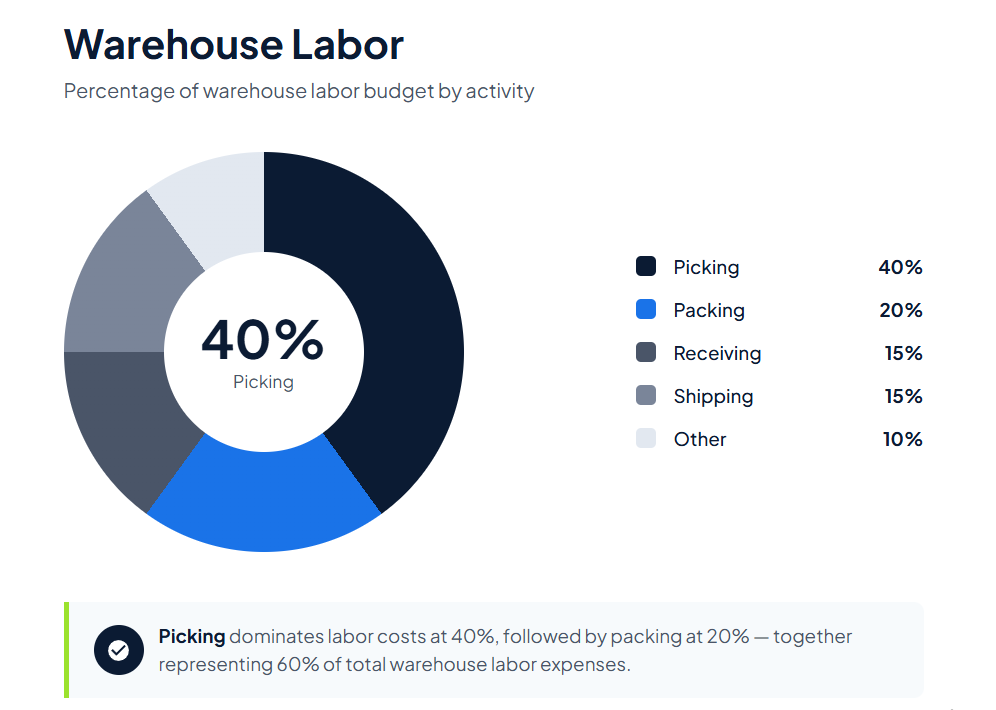
Warehouse configuration directly affects picker productivity. Every extra step workers take to retrieve items adds time and labor cost to each order.
Position high-velocity SKUs closest to packing stations. Analyze sales data to identify your fastest-moving products, then assign them to prime locations that minimize travel distance. Reserve distant or hard-to-reach areas for slow-moving inventory.
Then, the group frequently ordered items together based on historical order patterns. Store products that commonly ship together in proximity to reduce picker travel during multi-item orders.
Apply these tactics to improve your warehouse layout:
- Conduct ABC analysis to categorize inventory by velocity (A items = top 20% by sales volume).
- Place A items in the most accessible zones, typically golden zone shelving at waist height.
- Create dedicated zones for returns processing, separate from forward-pick areas.
- Review and adjust slotting positions monthly during peak seasons, quarterly during regular periods.
3. Adopt Batch and Zone Picking Methods
Single-order picking, or completing one order at a time, wastes significant labor through redundant travel. Optimizing picking methods is one of the most effective ways to improve your warehouse pick rate.
These alternative picking strategies consolidate trips and multiply throughput:
- Batch picking groups multiple orders together. Pickers retrieve items for 10-20 orders in a single warehouse pass, then sort products at a central station. This method works well when orders share standard SKUs.
- Zone picking assigns workers to specific sections of the warehouse. Each picker retrieves items only within their zone, passing partial orders to the next zone. This approach reduces congestion and allows workers to develop expertise in their assigned areas.
- Wave-picking schedules orders for release at specific intervals, coordinating picking activities with carrier pickup times. Morning waves prioritize overnight orders while afternoon waves focus on same-day requests.
4. Reduce Inventory Touches
Each time warehouse staff handle a product, the probability of error increases. Every touchpoint – including receiving, putting away, picking, packing, and shipping – can lead to damage, loss, or mistakes.
Map your current fulfillment workflow and count how many times products are handled between the dock and the delivery truck. Challenge each touch point: Is this step necessary? Can two steps be combined?
Cross-docking is one approach to reducing touch. Products arriving from suppliers move directly to outbound staging rather than entering storage. This works for predictable, high-volume items with immediate demand.
Slotting optimization is another approach. Positioning inventory to eliminate secondary handling, like moving products from bulk storage to pick locations, removes an entire touch category.
Consider these opportunities to reduce unnecessary touches:
- Receive inventory directly into pick locations when possible
- Eliminate intermediate staging areas between process steps
- Use pack-on-demand workflows where items go directly from pick to customer packaging
- Implement quality checks at receiving rather than at shipping
5. Invest in Automation Technology
Automation addresses fulfillment's biggest cost driver: labor. Warehouse automation technology can reduce labor costs by up to 60%, increase productivity by 30%, and decrease errors by up to 99%, according to studies.
Start with targeted automation rather than full facility transformation. Conveyor systems move products between zones without manual transport. Barcode scanning eliminates manual data entry. Pick-to-light systems visually guide workers to the correct locations.
Autonomous mobile robots (AMRs) represent the next tier. These devices transport products between zones, bring items to pickers (goods-to-person), or assist with putaway tasks. AMR implementations can deliver Return On Investment (ROI) payback within 24 months.
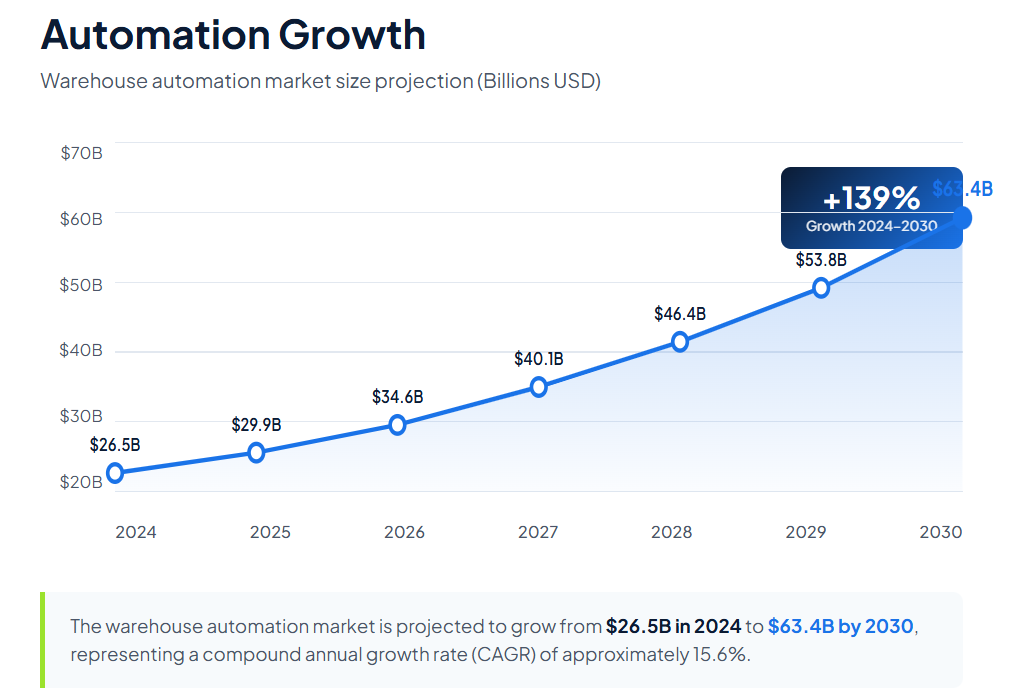
The warehouse automation market is projected to grow from $29.91 billion in 2025 to $63.36 billion by 2030, according to Mordor Intelligence. Organizations that delay automation investments risk falling behind competitors with lower cost structures. Supply chain data analytics can help identify where automation will deliver the highest ROI.
Follow this sequence when implementing automation:
- Barcode scanning for all inventory movements
- Conveyor systems for high-volume transport routes
- Pick-to-light or voice picking for order accuracy
- AMRs or automated storage and retrieval systems (AS/RS) for labor-intensive tasks
6. Establish Real-Time Inventory Visibility
Accurate inventory data prevents both stockouts and overstocking. Yet studies say that the average U.S. retail business has an inventory accuracy rate of only 66%.
Real-time tracking systems update inventory counts as products move through the warehouse. RFID technology, IoT sensors, and mobile scanning devices continuously capture location and quantity data, rather than relying on periodic physical counts.
Cycle counting replaces annual physical inventories with ongoing verification. Staff count a portion of inventory daily, rotating through all SKUs over time. This approach identifies discrepancies before they cascade into order fulfillment failures.
Use this checklist to improve inventory visibility:
- Implement barcode or RFID scanning at every inventory movement point
- Set automatic reorder points based on historical demand and lead times
- Configure low-stock alerts that trigger before stockouts occur
- Reconcile system counts with physical counts on a rotating schedule
- Track inventory accuracy as a KPI with targets above 95%
7. Standardize Packing Procedures
Packing inefficiency adds cost through wasted materials, dimensional weight charges, and damage claims. Professional contract packaging services can help establish and maintain these standards; their procedures ensure consistent results regardless of which staff member packs an order.
Document packing specifications for each product category. Define which box sizes accommodate which items, how much void fill to use, and which products require special handling. Post visual guides at packing stations.
Right-sizing packages matters for controlling shipping costs. Carriers charge based on dimensional weight, or the package's volume, when it exceeds actual weight. Using oversized boxes unnecessarily inflates shipping expenses. When products need to be reconfigured for different channels, repack and relabel services ensure proper packaging without waste.
Include these elements in your packing standardization program:
- Catalog of approved package sizes matched to product dimensions
- Void fill specifications to prevent damage without excess material use
- Quality check procedures before label application
- Exception handling protocols for fragile, oversized, or hazardous items
- Regular audits comparing actual packing practices to documented standards
8. Negotiate Carrier Relationships Strategically
Shipping costs represent a significant fulfillment expense, and carrier relationships directly affect both cost and service quality. Treat carriers as strategic partners rather than commodity vendors.
Consolidate volume with fewer carriers to gain negotiating leverage. Carriers offer better rates to customers who provide consistent, predictable volume. Track your shipping data to present concrete volume projections during rate negotiations.
Diversify enough to maintain options. Single-carrier dependency creates risk when that carrier experiences service disruptions. Maintain relationships with at least two carriers for each service level you offer customers.
Regional carriers often outperform national carriers for specific geographic areas. A regional provider might offer faster delivery times and lower costs within their coverage zone compared to major networks.
Adopt these practices to manage carrier relationships effectively:
- Review contracts annually and benchmark against current market rates
- Track on-time delivery performance by carrier and service level
- Establish escalation contacts for service failures during peak periods
- Consider zone-skipping strategies that inject shipments closer to destinations
- Evaluate last-mile delivery partners for urban areas with congestion challenges
9. Build Continuous Improvement Processes
Fulfillment performance requires ongoing attention. Markets shift, customer expectations evolve, and what worked last year may underperform today.
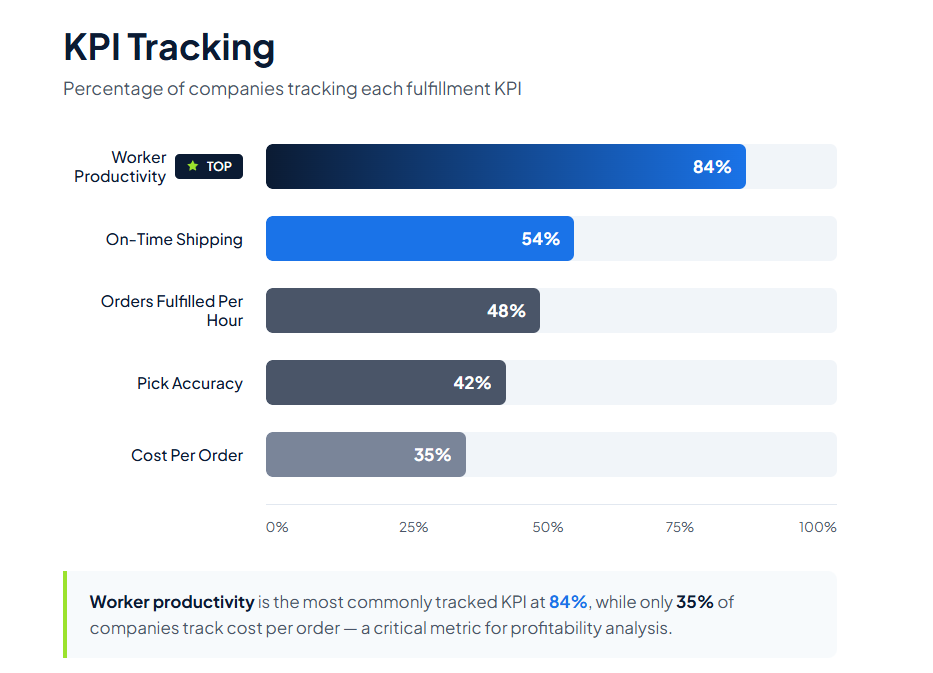
Establish key performance indicators and regularly review them. Common fulfillment KPIs include orders fulfilled per hour, pick accuracy rate, on-time shipping percentage, and cost per order. Dashboard these metrics for visibility across operations.
Conduct quarterly reviews of fulfillment processes. Walk the warehouse floor, observe actual workflows, and identify bottlenecks. Gather input from front-line staff who see inefficiencies firsthand.
Build your continuous improvement program around these practices:
- Set monthly targets for each fulfillment KPI
- Hold weekly standups to review performance and address issues
- Document process changes and measure their impact before making them permanent
- Benchmark against industry standards to identify improvement opportunities
- Schedule quarterly process audits with cross-functional teams
5 Benefits of Effective Fulfillment Processes
Organizations that implement fulfillment improvements consistently realize measurable business benefits. These advantages compound over time as efficiency gains free up resources for further investment.
- Lower operating costs. Reduced labor requirements, fewer errors to correct, and lower shipping expenses improve margin on every order. Warehouses using advanced automation report lower operational costs, with savings primarily attributed to labor efficiency gains.
- Faster order processing. Efficient processes accelerate the order-to-ship cycle. Automated picking systems can improve fulfillment speeds by up to 300%, according to studies. Faster processing enables same-day shipping commitments that attract customers.
- Higher order accuracy. Systematic picking and packing procedures reduce error rates. Organizations that implement WMS with barcode verification routinely achieve order accuracy rates above 99%, compared to 92-95% with manual processes.
- Improved customer satisfaction. Accurate orders that arrive on time generate positive reviews and repeat purchases. Customers who receive what they ordered when expected become advocates rather than detractors.
- Scalability for growth. Efficient processes handle volume increases without proportional increases in cost. Automated systems and optimized workflows allow warehouses to fulfill more orders with the same footprint and headcount.
Frequently Asked Questions
1. What is order fulfillment efficiency?
Order fulfillment efficiency measures how quickly and accurately a warehouse processes orders from receipt to shipment. Key metrics include orders fulfilled per hour, pick accuracy rate, and cost per order processed. Higher efficiency means faster order completion, fewer errors, and lower labor costs per unit shipped.
2. How much do picking operations cost?
Order picking typically accounts for 55% of total warehouse operating costs, according to research from the Georgia Institute of Technology. This percentage makes picking operations the largest single expense category in most fulfillment facilities. Reducing pick time through layout optimization, better methods, or automation delivers disproportionate cost savings.
3. What is the best order picking method?
The optimal picking method depends on order volume, product variety, and warehouse layout. Batch picking works well for high-volume operations with standard SKUs across orders. Zone picking is suited to large warehouses with diverse inventory. Wave picking coordinates picking with carrier schedules. Many operations combine methods based on order characteristics.
4. How does a WMS improve fulfillment?
A warehouse management system improves fulfillment by providing real-time inventory visibility, optimizing pick paths, validating accuracy through barcode scanning, and coordinating all warehouse activities. WMS implementations typically reduce picking errors, accelerate order processing, and improve inventory accuracy by capturing data systematically at each process step.
5. What warehouse automation should I implement first?
Start by scanning barcodes for all inventory movements before investing in more advanced automation. Barcode validation eliminates manual data entry errors and provides the accurate inventory data that other systems require. After scanning, consider conveyor systems for high-traffic transport routes, then pick-to-light or voice-directed picking to improve accuracy.
6. How do I measure fulfillment performance?
Track key performance indicators, including orders fulfilled per hour, on-time shipping rate, pick accuracy percentage, cost per order, and inventory accuracy rate. Review these metrics daily or weekly, depending on volume. Compare performance against prior periods and industry benchmarks to identify opportunities for improvement.
Key Takeaways
- Order picking accounts for 55% of warehouse operating costs, making it the highest-impact area for efficiency improvements.
- Warehouse management systems have become standard infrastructure, with over 90% of facilities using or planning to implement WMS.
- Warehouse layout directly affects labor productivity; position fast-moving items near packing stations and group frequently co-ordered products together.
- Batch, zone, and wave picking methods can multiply throughput compared to single-order picking for high-volume operations.
- Automation technology can reduce labor costs by up to 60% and decrease errors by up to 99%.
- Real-time inventory visibility prevents both stockouts and overstocking, achieving target accuracy rates above 95%.
- Continuous improvement processes ensure that fulfillment performance keeps pace with changing market conditions.
20 Years of Kitting Excellence
Ready to Streamline Your Supply Chain?
Join industry leaders achieving 99%+ SLA performance with flexible kitting, fulfillment, and 3PL solutions.
Get in Touch